Gunite vs shotcrete pools
Gunite vs shotcrete pools: what gunite is, dry mix vs wet mix, rebound, strength, cold joints, curing and cost, and what to ask the crew before they shoot.
Zsolt Kocsmarszky · Updated
Gunite and shotcrete are the same idea: concrete sprayed from a hose onto a cage of steel bars in the excavation, building the floor and walls of a pool in one piece, in any shape, with no formwork. The difference is where the water joins the mix. Gunite is dry mix: sand and cement blown down the hose and wetted at the nozzle. Shotcrete, as pool builders use the word, is wet mix: ready-mixed concrete from a truck, pumped down the hose and thrown at the wall with compressed air.
Builders argue about it with conviction, and each camp has a point. But the shell you'll swim in for thirty years depends far more on who holds the nozzle, how thick the walls are, whether the shoot stops halfway and how the concrete is cured than on which machine is parked in your drive. Whether to build in concrete at all is the fiberglass vs concrete question; this page assumes concrete and follows the day it's sprayed.
- rebound commonly quoted for dry mix on walls, against 5–10% for wet mix
- 15–30%rebound commonly quoted for dry mix on walls, against 5–10% for wet mix
- what a load of wet mix typically has from batching to the nozzle
- ~90 minwhat a load of wet mix typically has from batching to the nozzle
- a common minimum shell spec (4,000 psi), passed by both when shot well
- 28 MPaa common minimum shell spec (4,000 psi), passed by both when shot well
- the least time to keep a fresh shell wet, whichever method sprayed it
- 7 daysthe least time to keep a fresh shell wet, whichever method sprayed it
At a glance
| Gunite (dry mix) | Shotcrete (wet mix) | |
|---|---|---|
| Where the water goes in | At the nozzle, set by the nozzleman | At the batch plant |
| On site | Machine, compressor and dry mix | Pump and a relay of mixer trucks |
| Who controls the mix | The nozzleman, by feel | The plant, on a batch ticket |
| Rebound on walls | Commonly 15–30% | Commonly 5–10% |
| Dust and overspray | More | Less |
| Pausing mid-shoot | Fine for a short stop | Hard: a load has about 90 minutes |
| Strength, shot well | Passes a typical 28 MPa spec | Passes a typical 28 MPa spec |
| Cost | Comparable; local supply decides | Comparable; local supply decides |
| What decides the shell | Nozzleman, thickness, curing | Nozzleman, thickness, curing |
Gunite vs shotcrete: where the water goes in
With gunite, a machine in the road blows a dry blend of sand and cement through the hose with compressed air, and a ring of jets in the nozzle adds the water just before it leaves. The nozzleman sets the water with a valve and adjusts it by feel: wetter to hold on a vertical wall, drier on the floor. With shotcrete, the water went in at the batch plant: the concrete arrives mixed, a pump pushes it through the hose, and air at the nozzle throws it at the steel. The nozzleman controls the air and the aim, not the mix.
Strictly, both are shotcrete, dry-mix and wet-mix; Gunite began as a trade name for the dry process over a century ago, and in much of the US a gunite pool now means any sprayed pool. So ask which process a builder actually uses. Dry mix puts more judgement in one pair of hands and is dustier and slower; wet mix is faster and more uniform, and the crew must keep pace with the trucks.
The craft at the nozzle is the same either way: hold it square to the surface, wrap every bar so no hollow is left behind it, build the walls from the bottom up so nothing sags, and leave the surface rough for what goes on next. That craft, more than the process, is what you're hiring.
Rebound: the concrete that never makes it into the wall
Spray concrete at a wall and some of it bounces off, mostly coarse sand with little cement. That's rebound. The figures usually quoted in the trade are about 15–30% on walls for dry mix and roughly 5–10% for wet mix, less on floors. A skilled nozzleman brings both down; a mix that's too dry pushes them up.
Run that over an 26 × 13 ft (8 × 4 m) pool with 3′ 11″–5′ 11″ (1.2–1.8 m) depths: about 732 sq ft (68 m²) of floor and wall, so roughly 3,698 gal (14 m³) of concrete in place at 7 7/8″ (20 cm) thick. Getting it there, a dry-mix crew shovels out something like 528–1,057 gal (2–4 m³) of rebound, a wet-mix crew nearer 264 gal (1 m³). The waste is paid for either way, which is part of why the two end up costing about the same.
Rebound on the lawn is harmless; rebound left in the shell is not. Shot over in the floor, in the cove where floor meets wall or on the steps, it leaves a weak, sandy layer that can crumble or leak years later. A good crew blows it clear with an air lance and shovels the floor out as the walls go up. Ask where the rebound goes, and look at the floor before it's shot.
Is gunite stronger than shotcrete?
This is where the camps dig in. Gunite crews say dry mix can be placed with very little water, and less water makes stronger concrete. Shotcrete crews say their mix comes with a plant ticket showing exactly what's in it, while a gunite mix is only as consistent as the hand on the valve. Both describe their own best day. A common pool-shell specification is at least 28 MPa (4,000 psi) at 28 days, and shot and cured properly, both methods commonly pass it.
What makes a shell strong or weak is mostly not the process. It's whether the steel is fully wrapped with no voids behind the bars, rebound was kept out, the shell has the thickness the engineer's drawing asks for (commonly around 5 7/8–9 7/8″ (15–25 cm) in floor and walls, more in the top beam under the coping), it was shot in one run, and it was kept wet while it cured. A careless wet-mix shell baked by the sun is weaker than a careful gunite one, and the reverse is just as true.
To know rather than be told, ask for a test panel: the nozzleman sprays a wooden box beside the pool on the day, and a lab drills cores from it and crushes them. Cylinders filled from a wet-mix truck show what the plant delivered, not what was shot. Few owners ask; a builder who offers is telling you something.
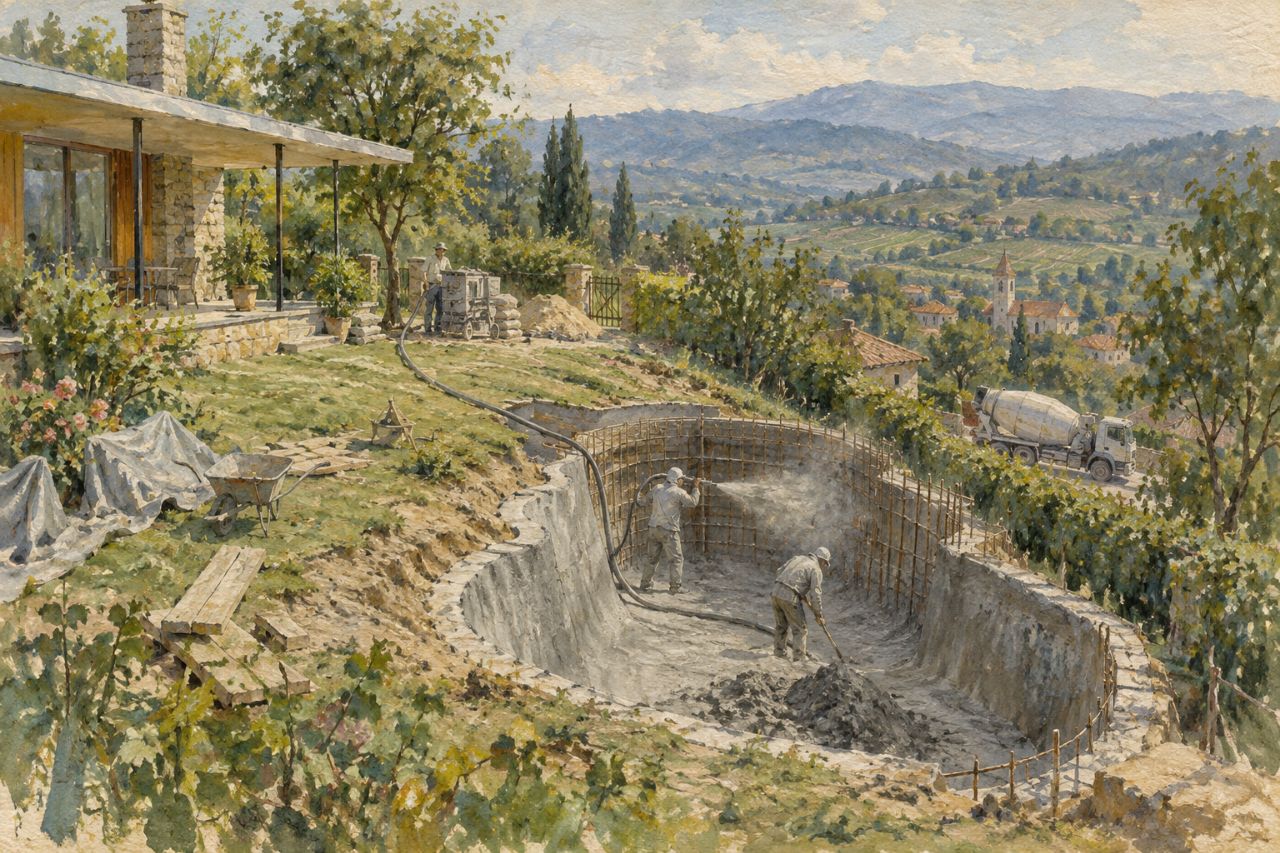
Cold joints, concrete trucks and the day of the shoot
A shell should be shot in one continuous run, usually a single day for an ordinary garden pool. Spray fresh concrete against concrete that has started to set and the two never fully knit: that seam is a cold joint, a weak plane and a possible leak path. If a stop can't be avoided, the edge should be trimmed back to a slope, cleaned and dampened before shooting resumes, never butted square against a hardening face.
Here the methods really differ. Dry material doesn't set in the hose, so a gunite crew can pause for a blocked line or a shower, as long as the pause is short. Wet mix starts setting once it's batched, and a load typically has about an hour and a half to be placed. A shotcrete shoot is a relay of two or three truckloads for a pool around 26 × 13 ft (8 × 4 m), and a truck stuck in traffic leaves the crew waiting while the edge they just shot stiffens. Ask how the loads are booked and what happens if one is late.
Access is easier than people expect: the machine or the pump stays in the road and the hose comes through the side gate. Gunite is the messier, so cover the cars and warn the neighbours. Neither should be shot in rain or with frost forecast, and in hot, windy weather a good crew starts at first light.
Curing, and what it means for plaster and tile
Concrete doesn't harden by drying; it hardens by reacting with water, for weeks if the water is there. A shell that dries out in its first days ends up weaker and cracked at the surface, whichever method sprayed it. So keep it wet for at least the first seven days: hosed down several times a day, more in heat or wind, or covered with wet burlap. Plain water is the safe choice, because some spray-on curing compounds leave a film the plaster struggles to bond to. In the US the owner is often handed the hose, so ask who waters and for how long.
Then the shell waits a few weeks for its finish, with the coping and waterline tile set in between, which is a good part of how long a pool takes to build. Walk round it meanwhile: look for honeycombed patches, exposed steel and cracks, and tap the walls. A hollow sound means a void or a layer that didn't bond, cheap to fix now and expensive under plaster.
Neither method limits the finish. Plaster, pebble and tile go on either shell if it was left rough rather than trowelled smooth, cleaned of overspray and shot true, because a wavy wall becomes a wavy tile line. In Europe the shell is more often rendered level, waterproofed and tiled, or lined with a welded PVC membrane. Which finish to choose is covered in tile vs plaster.
What gunite and shotcrete cost
About the same. The method changes one part of the quote, the shell: steel plus spraying. One published US cost guide puts the spraying for a typical pool at roughly $12,000–30,000 and the steel at $4,000–8,000; the plan pages on this site put a whole 16x32 concrete pool at about $71,000–114,000, installed with basic coping, before deck, fence, heating and permits. Published German prices for a builder's concrete shell run around €180–320 per square metre of floor and wall, so about €12,000–22,000 for the 732 sq ft (68 m²) of an 26 × 13 ft (8 × 4 m) pool, of the €45,000–74,000 the plan pages put on the whole tiled concrete pool. Either way the shell is a quarter to a third of the bill, and the method moves only part of that.
Where the two differ, the costs pull opposite ways: dry mix uses cheaper materials but wastes more as rebound and goes slower; wet mix pays for ready-mixed concrete, a pump and the trucks' minimum loads, and goes faster. Which wins depends on how far the plant is and which crews work near you, so compare whole quotes on the same drawing, not methods.
To see where your own pool lands, draw it in the designer: the live cost estimate gives a total for what you've drawn, and Pro's cost breakdown by building stage shows the shell and structure as a line of its own, the line this choice moves.
Sprayed, cast or block-built: the other ways to build in concrete
Sprayed shells are the usual concrete pool in the US and Australia and common in Spain, but in Central Europe they're the exception. There the everyday concrete pool is built from hollow concrete or polystyrene blocks, filled with concrete and lined with a PVC membrane; the high end is cast in place between formwork in watertight reinforced concrete, then tiled. The guide to concrete, fiberglass and vinyl pools compares the types; here the question is only how the concrete gets into the wall.
Spraying earns its place where the shape is free: with no formwork, a curve, a bench or a set of Roman steps costs little more than a straight wall, and floor and walls go on as one piece, with no joint at the foot of the wall to seal with a waterstop. Against it, the crews are thin on the ground in much of Europe, and the rougher surface wants a levelling render before tile. Cast walls are dense and dead straight, ideal for big rectangles and overflow edges, but every curve is carpentry; blockwork is the cheapest and leaves the watertightness to its membrane. For a rectangle all three can be excellent; for a freeform, spraying is usually the sensible way.
What to ask before anyone shoots
Start with the person. Who is the nozzleman, how many pools have they shot, and will they be on your job? In the US the American Concrete Institute certifies shotcrete nozzlemen for dry mix, wet mix or both. It isn't usually required for a residential pool, so plenty of good nozzlemen don't hold it, but a builder who can name a certified one has invested in the skill that matters most. And ask which process they really use.
Then the shell. What thickness does the drawing give for floor, walls and top beam, and how will they check it on the day? Will it be shot in one run, and what's the plan if a truck is late or the machine fails? Where does the rebound go? Will they shoot a test panel? Who keeps the shell wet? The wider list is in the questions to ask a pool builder.
Then decide. Either process can make an excellent shell, and neither rescues a careless crew. If two good builders quote, one gunite and one shotcrete, choose the one whose answers are specific, with names, numbers and a plan for the bad day, and let them shoot the method they shoot every week. Draw the pool to scale in the free designer first and give every builder the same drawing, so they all price the same shell.
Either can make an excellent shell, and neither rescues a careless crew. Choose the builder, not the process: an experienced nozzleman (in the US, ideally ACI-certified), a shell thickness written on the drawing, one continuous shoot with a plan for a late truck, and a week of wet curing. Then let them shoot the method they shoot every week.
Frequently asked questions
- What is gunite?
- Gunite is dry-mix sprayed concrete: sand and cement blown dry through a hose, with water added at the nozzle. Sprayed onto a steel cage in the excavation, it forms a pool shell of any shape in one piece, finished with plaster, pebble or tile.
- What's the difference between gunite and shotcrete?
- Where the water is added. Gunite is mixed dry and wetted at the nozzle by the nozzleman; shotcrete, as pool builders use the word, is ready-mixed concrete pumped from a truck. Strictly, both are shotcrete.
- Is gunite or shotcrete better for a pool?
- Neither in itself. Both make a strong, watertight shell when an experienced nozzleman shoots it to the specified thickness in one run and it's kept wet while it cures. Choose the crew, and let them use the method they know.
- Is gunite stronger than shotcrete?
- Not categorically. Dry mix can be placed with less water; wet mix arrives with a consistent, documented mix. Shot and cured properly, both commonly pass a typical 28 MPa (4,000 psi) shell specification.
- Does a gunite pool cost more than a shotcrete pool?
- Generally not by much. The method affects only the shell, roughly a quarter to a third of a concrete pool's price, and local supply decides which is cheaper. Compare whole quotes for the same drawing.
- How long does a gunite shell need to cure?
- Keep it wet for at least the first seven days, several times a day in hot or windy weather. Most builders then wait a few weeks before plaster or tile.

Go on — put a pool in your garden.
Open the designer and see it in 3D tonight. Free, no signup.
Start designing — it's freeFree · no signup · runs in your browser