- typical life of a vinyl liner before it's replaced
- 8–12 yrstypical life of a vinyl liner before it's replaced
- between plaster resurfacings on a concrete pool
- 10–15 yrsbetween plaster resurfacings on a concrete pool
- to set a fiberglass shell once the hole is dug
- 1–2 daysto set a fiberglass shell once the hole is dug
- a typical concrete build, from dig to first swim
- 2–4 monthsa typical concrete build, from dig to first swim
The decision under all the others
Most people start with shape, or size, or the color of the water in a photo. Builders start somewhere else: what the pool is made of. Concrete, fiberglass or vinyl liner decides which shapes are possible, how long the build takes, what the finish feels like under your feet, what you'll spend on chemicals and what you'll be paying for again in ten years.
It also decides who you call. Plenty of builders only do one of the three, and every one of them will tell you, with total conviction, that theirs is the right one. They're not lying. Each type is genuinely the best answer for somebody, and the trick is working out which somebody you are before the sales conversation starts.
So here's the plain version: how each one is built, what it's good and bad at, and what I'd pick in which yard.
How each one is built
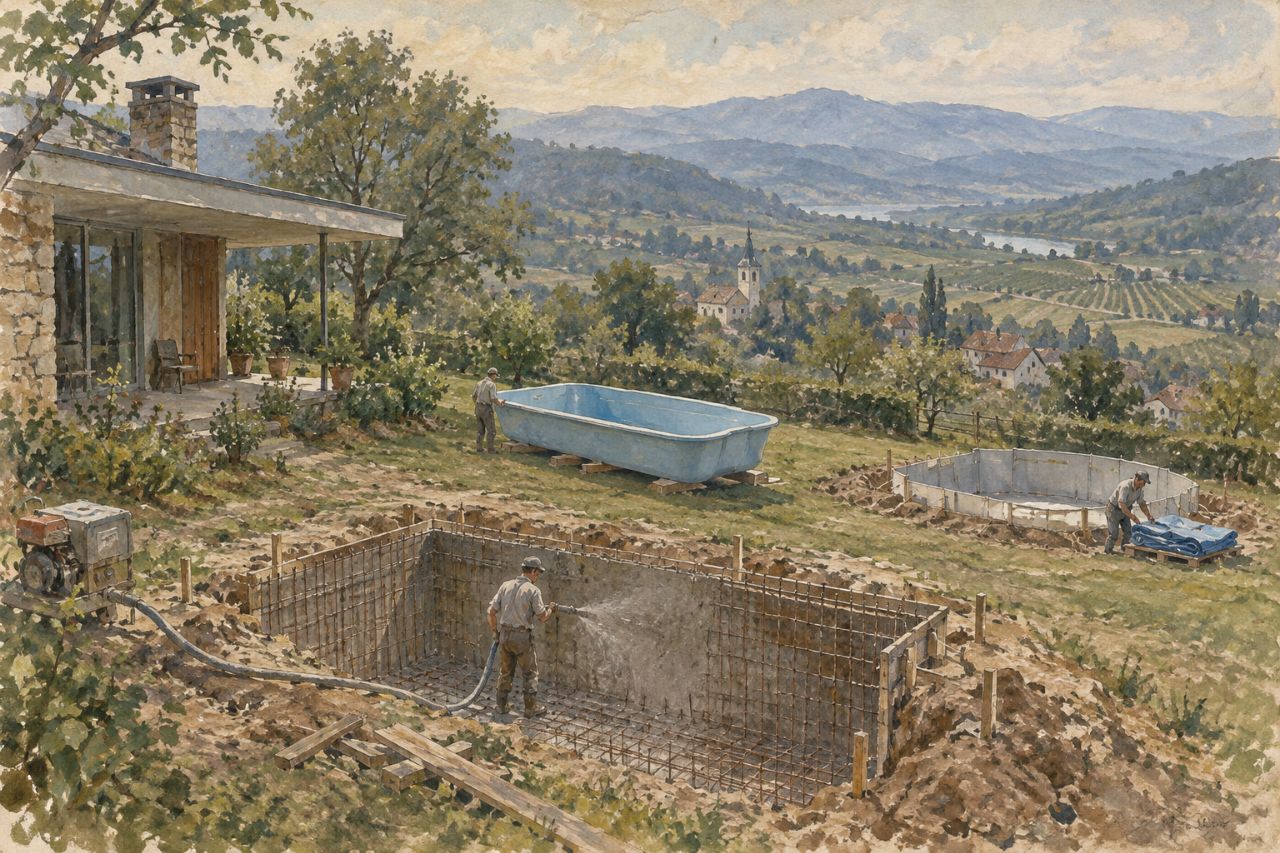
A concrete pool is built in place. The crew digs the hole, ties a cage of steel rebar to the exact shape, then sprays concrete onto it: gunite if the dry mix meets its water at the nozzle, shotcrete if it arrives wet from a truck. The shell cures for weeks, then gets its interior finish, usually plaster, a pebble aggregate or tile. Every pool is a one-off, shaped by hand.
A fiberglass pool is built in a factory. The shell is laid up in a mold, gelcoat first, then layers of glass fiber and resin, and it arrives on a truck in one piece. The hole is dug slightly oversize, a bed of gravel or sand goes down, a crane swings the shell in, and the backfill goes in while the pool is filled with water so the pressure stays even on both sides of the wall.
A vinyl liner pool is built from a kit. Wall panels of steel or polymer are bolted together on site and braced, the floor is troweled from a sand-cement mix or a vermiculite blend, and a custom-cut vinyl sheet hangs from a track along the top of the wall. Water pulls it tight against the walls and floor. The liner is the waterproofing and the finish in one layer, which is the whole point, and its weakness.
Why the map of America splits three ways
Drive from Phoenix to Boston looking over fences and you'll see the pattern. Concrete dominates the Sun Belt: Arizona, Texas, Florida, Southern California. The season there runs most of the year, there's no deep frost to heave a rigid shell, and the market grew up around big concrete builders who could turn out custom shapes quickly. When a pool is open ten months a year, people spend more on it.
Vinyl liner is the traditional Northeast and Midwest pool. The season is short, so a lower upfront price makes more sense for a pool that sits under a winter cover half the year, and the panel walls cope well with frost moving the ground. Many builders there grew up installing kits, and the parts supply followed them.
Fiberglass is the one that's been gaining everywhere. Faster installs, lower upkeep and a smooth finish sell well in any climate, and the only thing that really holds it back is the road: a shell has to fit on a truck, and the farther you are from the factory, the more the delivery costs.
The type of pool isn't a finish you choose at the end. It's the thing that decides which finishes you get to choose.
What each lets you draw
Fiberglass is a catalogue. You choose a model, and the shape, the steps, the benches and the depth come with it. Transport sets the ceiling: shells top out at roughly 16′ 1″ (4.9 m) wide and around 39′ 4″ (12 m) long, because anything bigger can't go down a highway without a permit and an escort, and many models are smaller. The upside is that the catalogue has been refined; the steps are comfortable because thousands of people have used them.
Vinyl is flexible within the kit. Rectangles, L-shapes, grecian corners, freeform curves and big sizes are all possible, and the depth can drop to a deep end. What you give up is detail: a tanning ledge, a built-in bench or a raised wall is possible but awkward, because it all has to be wrapped in one sheet of vinyl without wrinkles.
Only concrete is truly freeform. Any outline, any depth, and it takes whatever you want to put on it or in it: full tile, a deck-level overflow edge, a vanishing edge, an attached spa spilling into the pool, a sun shelf of any size. If the pool you're picturing came from a magazine, it was almost certainly concrete. That's worth knowing before you fall in love with a picture.

Lifespan and what you'll renew
No type lasts forever untouched; they just wear out in different places. A vinyl liner typically needs replacing every 8 to 12 years, sooner in strong sun or with careless chemistry. It's a routine job, a day or two for the crew, but it runs to several thousand dollars each time, and a liner that's faded and wrinkled is the first thing a buyer notices.
A concrete shell will outlive you, but its finish won't. Plaster usually needs resurfacing every 10 to 15 years, pebble finishes last longer, and tile can go decades with some regrouting. Resurfacing means draining the pool and is usually a five-figure job. Budget it the day you sign, not the day the plaster starts to feel like sandpaper.
Fiberglass gelcoat is the long-lived one: decades is realistic with sane water chemistry, and there's no scheduled renewal in the way the other two have. The catch is repairs. A crack, blistering or fading gelcoat needs a specialist, color matching is hard, and a bad patch shows. It happens rarely, but when it does, the local handyman can't help.
Feel, algae and chemicals
Vinyl is soft underfoot, the kindest surface for small kids' knees. It's also the easiest to damage: a dog's claws, a dropped pool tool or a sharp toy can puncture it. Patches are easy; invisible patches aren't.
Fiberglass is smooth and nonporous, so algae has little to hold on to. That's the real reason fiberglass owners report using fewer chemicals and brushing less. The floor can feel a bit slick, and good shells have textured steps and benches for that reason.
Plaster is porous and slightly rough, which is why concrete pools need the most attention. Algae finds the pores, fresh plaster pushes the pH up for weeks, and you'll brush more and add acid more often. Tile and pebble finishes cut that down, and a good automatic dosing system cuts it further. None of it is hard work, but over twenty years it adds up to real money and real weekends.
Time, money and the 20-year view
Install time follows the method. A fiberglass pool can go from dig to water in two to four weeks, most of which is plumbing, backfill and deck. Vinyl typically takes three to six weeks. Concrete is two to four months and sometimes more, because the shell has to cure and the finish trades follow one another. If you want to swim this summer and it's already May, that alone may decide it.
Upfront, vinyl is usually the cheapest of the three for a given size, fiberglass sits in the middle, and concrete costs the most, with a wide overlap because site, access and the deck move every number. Over twenty years the order often changes. Vinyl picks up one or two liner replacements, concrete picks up a resurfacing and a heavier chemical and power bill, and fiberglass tends to come out lowest because it asks for so little along the way.
Climate sits on top of all this. Freeze-thaw is hard on rigid things, so a concrete pool in a cold state needs careful winterizing and good coping details. Groundwater is the fiberglass risk: an empty shell in wet ground can float up out of the hole, which is why nobody should drain one without asking the installer first. Vinyl liners float too if the water table rises while the pool is low. Wherever the water table is high, the builder should be talking about it before you are.
Choose this one if…
Choose concrete if you want a shape nobody else has, an overflow or vanishing edge, full tile or an attached spa, if you live where the pool is open most of the year, or if you're building a pool as the centerpiece of a house you'll stay in. Accept that it costs the most, takes the longest and asks for the most care.
Choose fiberglass if a catalogue model fits your yard and your plans, you want the least upkeep and the fastest build, and a truck and crane can reach the site. Draw the shell to scale before you pick a model; a design at 16′ 1″ (4.9 m) wide looks very different on the lawn than in a brochure. The free PoolPlanner designer is a quick way to check that the model you like actually fits beside the patio.
Choose vinyl if you want a big pool for a sensible price, you're in a cold climate with a short season, or you want a size or shape the fiberglass catalogue doesn't offer. Budget the liner replacements from day one and pick a liner pattern you'll still like in year ten. On resale, buyers in the Sun Belt tend to expect concrete, buyers in the North are used to vinyl, and fiberglass reads as low-maintenance nearly everywhere.
Before you call a builder
- Write down the shape and features you actually want, then see which types can build them.
- Check truck and crane access to the yard if fiberglass is on the list.
- Ask a neighbor or the building department how high the water table sits in your area.
- Put the renewal in the budget: a liner every 8–12 years or a resurfacing every 10–15.
- Ask each builder which types they install, and talk to at least one for each type you're weighing.
- Compare install times against when you actually want to swim.
- Ask how the finish holds up to salt if you're planning a salt system.
- Draw the pool to scale on your own lot before you pick a model or a size.
What goes wrong in practice
Falling for a picture of the wrong type
The vanishing-edge pool on the mood board was concrete. Ask a fiberglass dealer for it and you'll get the nearest catalogue shell, which isn't the same pool.
Comparing upfront prices only
Vinyl often wins on day one. Add one or two liners, or a resurfacing and twenty years of extra chemicals, and the ranking can flip.
Picking a fiberglass model before checking the route
The shell has to come down your street and over your house or fence on a crane. A narrow lane, overhead wires or no crane position can rule a model out after you've chosen it.
Draining a pool to fix something
Fiberglass shells and vinyl liners can lift in wet ground, and even concrete can. Never empty a pool without the installer's say-so and a plan for the groundwater.
Letting the builder's type choose for you
A builder who only installs one type will recommend that type. Talk to one of each before you decide, then pick the builder.
Frequently asked questions
- What are the 3 types of inground pools?
- Concrete (sprayed as gunite or shotcrete and finished in plaster, pebble or tile), fiberglass (a one-piece factory shell set in the ground by crane) and vinyl liner (a kit of wall panels lined with a custom vinyl sheet). They differ in shape freedom, upkeep, lifespan, install time and cost.
- Which type of pool is best?
- There's no single best. Concrete is best for custom shapes, tile and overflow or vanishing edges; fiberglass for low upkeep and a fast install; vinyl for a large pool at a lower upfront price, especially in cold climates.
- Is fiberglass or concrete cheaper over time?
- Fiberglass usually costs less over twenty years. It needs no scheduled resurfacing and typically uses fewer chemicals, while a concrete pool needs new plaster every 10 to 15 years and more care in between.
- How long does a vinyl liner last?
- Typically 8 to 12 years. Strong sun, poorly balanced water and sharp objects shorten it. Replacing a liner is a routine job that takes a day or two, but budget several thousand dollars for it.
- How big can a fiberglass pool be?
- Shells are limited by road transport, so they top out at roughly 16′ 1″ (4.9 m) wide and about 39′ 4″ (12 m) long, and many models are smaller. For anything larger, or a custom shape, you need concrete or vinyl.
- Which pool type is best for cold climates?
- Vinyl and fiberglass both cope well with frost because they flex slightly as the ground moves. Concrete works too, but it needs careful winterizing and good detailing at the coping and tile line.
