Lap pool vs swim spa
Lap pool vs swim spa: real laps with turns, or swimming in place against a counter-current. Garden space, water, heating, build, cost and winter use.
Zsolt Kocsmarszky · Updated
Both promise a swim before breakfast in your own garden, and they deliver it in opposite ways. A lap pool is a long, narrow in-ground pool, usually 39′ 4″–82′ (12–25 m), that you swim up and down, turning at each wall. A swim spa is a factory-made acrylic tub of about 13′ 1″–19′ 8″ (4–6 m), delivered on a truck, in which you swim in place against a current. One is part of the garden; the other is closer to an appliance.
The table above is the short version. Below are the reasons, with the numbers worked through, so you can decide with your own garden and your own swimming in mind.
- a lap pool's usual length; 10 m is the floor
- 12–25 ma lap pool's usual length; 10 m is the floor
- a swim spa's length, at about 2.3 m wide
- 4–6 ma swim spa's length, at about 2.3 m wide
- water in a 12 × 2.5 m lane and in a 5 m swim spa
- 40 vs 10 m³water in a 12 × 2.5 m lane and in a 5 m swim spa
- a swim spa's season, against about five for a heated, covered pool
- 12 monthsa swim spa's season, against about five for a heated, covered pool
At a glance
| Lap pool | Swim spa | |
|---|---|---|
| How you swim | Real lengths: push off, glide, turn | In place, against a current |
| Length | 12–25 m; 10 m at the very least | About 4–6 m; 5 m+ to swim well |
| Garden it takes | A 60–120 m² strip with a metre of deck | About 20–25 m² in a corner |
| Water to heat | About 40–85 m³ at 2.5 m wide | About 7–12 m³ |
| Season outdoors | May–September, with heat pump and cover | All year, under an insulated lid |
| Build | Dug and built on site: 2–12+ weeks | Craned onto a slab, or part-sunk |
| Cost | €34,000–98,000 for 12 × 4 m, pool only | Often $/€20,000–50,000, plus slab and crane |
| Family use | Several swimmers, children, parties | One swimmer; a hot tub with the current off |
| Moves house with you | No | Yes, by crane |
| Best for | Training swimmers with the length | Fitness and winter swimmers, small gardens |
Lap pool or swim spa: which should you build?
Build a lap pool if your garden takes at least 39′ 4″ (12 m) of water and you swim to train. Build a swim spa of 16′ 5″ (5 m) or more if it doesn't, or if you swim for fitness and want to do it in January.
A 39 × 8 ft (12 × 2.5 m) lane at 4′ 5″ (1.35 m) holds about 10,567 gal (40 m³), needs a strip of garden about 45′ 11″ (14 m) long once a metre of deck goes round it, and is swimmable from about May to September with a heat pump and a cover. A 16′ 5″ (5 m) swim spa holds about 2,642 gal (10 m³), sits on a slab in a corner and stays warm all year under its insulated lid, but you never leave the spot you started from. The choice goes wrong in one predictable way: buying for the swimmer you imagine rather than the one you are.
Is swimming in a swim spa like swimming laps?
No. In a lap pool every length has a shape: push off, glide, settle into the stroke, turn. A moderate swimmer reaches the far wall of a 39′ 4″ (12 m) pool in about fifteen seconds, so the turns set a rhythm and give you a breath of rest, and the distance is real: count the lengths and you know how far you swam. You can train the way a club does, with intervals, drills and turns.
In a swim spa you hold your position against moving water. There is no glide and no turn, so the effort never lets up, and the end wall is a metre or two from your face. The only measures of distance are the current setting and the clock. Many people find that suits them; some find it monotonous, or never settle with the wall that close.
So a club or masters swimmer, or anyone working on turns and pace, wants the lap pool. A fitness swimmer doing a steady twenty or forty minutes, someone swimming for a bad back, or anyone who wants water exercise as much as swimming does well in a swim spa. Triathletes are the interesting case: open water has no walls either.
What makes a good current, and how to test one
The current is the whole product, and it varies between models more than anything else on the spec sheet. A good one is wide enough to cover both arms through the stroke, deep enough to carry your legs, smooth enough not to push one shoulder harder than the other, and at full strength faster than your steady pace. Most swim spas make it with jets fed by two or three pumps; some use a propeller behind a grille, which tends to move a broader, calmer column of water.
Length matters as much as power. Stretched out with your arms forward you are about half a metre longer than you are tall, 7′ 3″–7′ 10″ (2.2–2.4 m) for most adults, and the kick and the current need room on either side of that. Most swimmers are comfortable in models of 16′ 5″ (5 m) and up; many feel cramped in the 13′ 1″ (4 m) ones.
Test before you buy, in swimwear, for twenty minutes: your normal pace, then faster, breathing to both sides, and the stroke you swim worst. Strong swimmers should ask about a tether, a belt on a cord fixed to the end wall, which lets you swim harder than the current pushes.
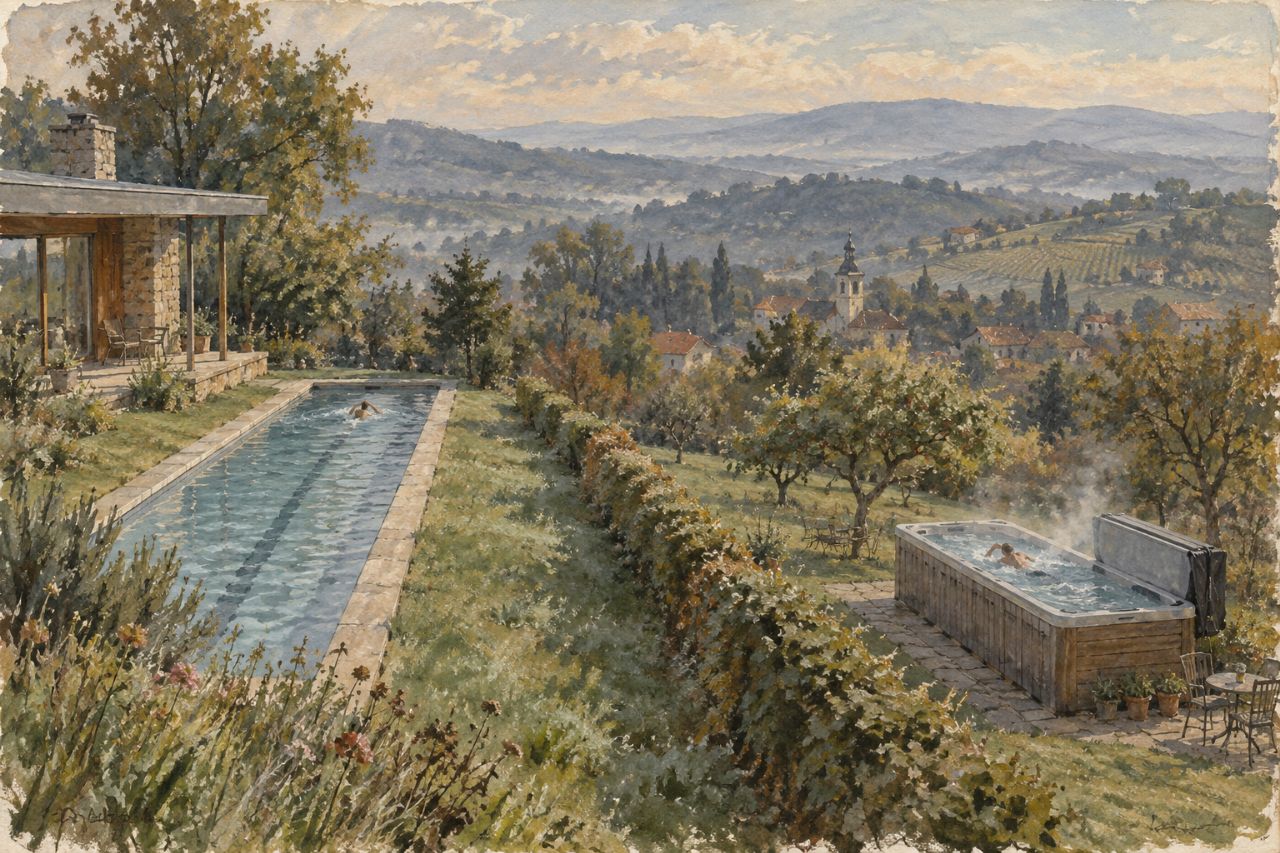
How much garden does each one take?
A lap pool takes a strip, and the strip is longer than the water. With a metre of walkable deck round a 39 × 8 ft (12 × 2.5 m) lane you need about 46 × 15 ft (14 × 4.5 m), a little over 646 sq ft (60 m²); a 82′ (25 m) lane takes about twice that. Add 16–22 sq ft (1.5–2 m²) for the filter, pump and heat pump within about 32′ 10″ (10 m) of the water. In many gardens that is the whole length of the lawn.
A swim spa takes a corner. Most are 13′ 1″–19′ 8″ (4–6 m) long and around 7′ 7″ (2.3 m) wide, a width that travels by road, and with steps on one side and room to fold back the lid and reach the service panels, a 16′ 5″ (5 m) model wants about 215–269 sq ft (20–25 m²). Pumps, heater and cartridge filter live in its cabinet, so there is no plant room. What it has instead is height: on its slab it is a box about 4′ 3″–4′ 11″ (1.3–1.5 m) tall, and it needs steps, decking or planting along two sides to look intended.
Try both in the garden itself. Open one of the lap pools in the plan library in the designer, set the width to 8′ 2″ (2.5 m) and the length to what the garden allows, and see where the lane lands; then peg out 16 × 8 ft (5 × 2.3 m) where a swim spa would stand. One of the two usually drops out the moment you do.
Which costs more to heat and run?
Take that 39 × 8 ft (12 × 2.5 m) lane at 4′ 5″ (1.35 m): about 10,567 gal (40 m³), with 323 sq ft (30 m²) of surface. A 16′ 5″ (5 m) swim spa holds about 2,642 gal (10 m³) once its moulded seats and steps have taken their share, with roughly 97 sq ft (9 m²) of surface; across the usual sizes it is 1,849–3,170 gal (7–12 m³). Raising one cubic metre of water by one degree takes 1.16 kWh, so the lane needs about 47 kWh per degree and the swim spa about 12.
The heaters narrow that gap. The lane gets a heat pump of about 48,000 BTU/h (14 kW), by the usual rule of 0.3–0.4 kW per cubic metre, and a heat pump delivers four to six times as much heat as the electricity it uses: 8–12 kWh per degree, a little over three hours each. Most swim spas heat with a plain electric element, often 10,000 BTU/h (3 kW) in Europe: 12 kWh per degree, about four hours each. Per degree, the two use about the same electricity, unless the swim spa's maker offers a heat pump for it.
What separates them is loss and months. The swim spa loses far less: a quarter of the water, under a third of the surface, an insulated cabinet and a foam-cored lid. The lap pool is warm on far fewer days: heated from May to September and then winterized, about 150 days against 365. Over a year the two bills land much closer than their volumes suggest. Cover the lap pool every night, and ask the swim spa's maker for its measured standby use, which decides its winter bill. The swim pumps draw several kilowatts, but only while you swim: a few kWh a session.
How each is built, how long it takes and what it costs
A lap pool is dug and built where it stands: tiled concrete, a liner on panel walls or, up to about 39′ 4″ (12 m), a one-piece fiberglass shell, plus a plant room, pipe runs and a deck. On site that is two to four weeks for fiberglass, three to six for a liner and eight to twelve or more for concrete, after the usual three to six months of quotes, permits and waiting for a builder.
A swim spa arrives finished, and what you build is the base: a level, reinforced concrete slab, usually 3 7/8–5 7/8″ (10–15 cm) thick and to the maker's drawing, because 2,642 gal (10 m³) of water weighs ten tonnes. Add a dedicated electrical supply with residual-current protection and a route for the crane, which often lifts it over the house, and you can be swimming within weeks of the order. Setting it into the ground or a deck looks better and costs more: you are then building a drained pit with room to reach the service panels.
The plan pages on this site put the 39 × 13 ft (12 × 4 m) lap pool at about €34,000–59,000 as a one-piece fiberglass shell, €38,000–66,000 as a liner pool and €59,000–98,000 in tiled concrete, and the US 10x40 lap plan at $40,000–60,000 in vinyl and $63,000–100,000 in gunite: the pool with basic coping, before deck, fence, heating and permits. A swim spa is often 20,000 to 50,000 in dollars or euros, more for the largest, usually with its heater and lid but not the slab, the crane or the wiring. Cheaper, then, but a quarter of the water is not a quarter of the money.
Winter, children, noise, permits and how long each lasts
Year-round use is the swim spa's real argument: at 26–28 °C (79–82 °F) it is a swim in January with steam coming off the water. Many have a separate hot-tub section or heat the whole tub to 36–38 °C for a soak, though a single-zone model can't be both at once. An outdoor lap pool gets its five months; swimming in it in winter means an enclosure, which is a different project.
For a family the lap pool is the better pool: several people at once, children playing at 4′ 5″ (1.35 m) once they can swim. A swim spa takes one swimmer, or a few people sitting with the current off, and like any hot tub it wants a locking lid and an adult nearby. Its swim pumps are the loudest machine either option owns and run when you swim, often early or late, so keep it away from bedroom windows, yours and the neighbours'.
An in-ground lap pool is a pool to any authority, with the permit and barrier rules our guide to pool permits and fences walks through. A freestanding swim spa is often treated like a hot tub, and some places accept a lockable cover as its barrier, but a sunk one may count as a pool: ask your local authority before you order. The lap pool's shell outlasts its owners, with a new liner every 8–12 years or new plaster every 10–15; the swim spa is a long-lived appliance whose pumps, heater, controls and lid are replaced as they wear, and it moves house with you.
Choose a lap pool if… choose a swim spa if…
Choose a lap pool if the garden gives you 39′ 4″ (12 m) or more of clear water, ideally 49′ 3″ (15 m), if you swim three or more times a week for distance and pace, and if a May-to-September season is enough; then build it the way the lap pool guide describes. Choose a swim spa if the garden can't give you 32′ 10″ (10 m), if you swim for fitness or health rather than for times, if winter is the point, or if you may move within ten years. Buy at least 16′ 5″ (5 m), and swim in it first.
Either way, price the middle road before you sign: a compact in-ground pool of about 20 × 10 ft (6 × 3 m) with a strong counter-current unit in its end wall. It swims in place like a swim spa and is a family pool with the current off. The plan pages put that 20 × 10 ft (6 × 3 m) at about €19,000–32,000 as a fiberglass shell, €22,000–37,000 as a liner pool and €33,000–54,000 in tiled concrete, and the cost research behind them adds €1,500–4,000 for the unit. Heated and covered it has a long season, though not a winter one.
If the garden gives you 12 m of water or more and you swim to train, build the lap pool: nothing in a box replaces real lengths and turns. If it doesn't, or you swim for fitness and want to swim in January, a swim spa of 5 m or more is the better buy, once you have swum in it for twenty minutes. Before you sign either, price a compact pool with a strong counter-current unit.
Frequently asked questions
- Is a swim spa as good as a lap pool for swimming?
- For steady fitness swimming a good one comes close; for training it does not. There is no glide, no turn and no distance to count, so club swimmers usually miss the lane. Swim in one for twenty minutes before you decide.
- How long should a swim spa be?
- At least 16′ 5″ (5 m) for most adults. A swimmer stretched out is about 7′ 3″–7′ 10″ (2.2–2.4 m) long, and the kick and the current both need room, so the 13′ 1″ (4 m) models suit water exercise better than swimming.
- Is a swim spa cheaper than a lap pool?
- Usually to buy: often 20,000 to 50,000 in dollars or euros, against €34,000–98,000 for a 39 × 13 ft (12 × 4 m) lap pool on this site's plan pages, before deck, heating and permits. It is kept warm all year, though, so the running costs end up closer than the volumes suggest.
- Can you use a swim spa in winter?
- Yes, that is its strongest argument: an insulated cabinet and lid keep about 2,642 gal (10 m³) at swimming temperature right through the winter. Keep it running in frost, or have it drained and winterized properly.
- What is the difference between a swim spa and a counter-current pool?
- A swim spa is a factory-made acrylic tub with its own pumps, heater and lid, set on a slab. A counter-current pool is an ordinary in-ground pool, usually 16′ 5″–23′ (5–7 m) long, with a counter-current unit in one end wall: part of the garden, and a family pool with the current off.
- Do I need a permit for a swim spa?
- It depends on where you live. A freestanding swim spa is often treated like a hot tub, a sunk one may count as a pool, and the wiring always needs an electrician. Ask your local authority before you order.

Go on — put a pool in your garden.
Open the designer and see it in 3D tonight. Free, no signup.
Start designing — it's freeFree · no signup · runs in your browser