- across inside, a typical attached spa
- 2.1–2.4 macross inside, a typical attached spa
- of water, with the bench about halfway down
- 0.9 mof water, with the bench about halfway down
- adults it really seats, whatever the brochure says
- 4–6adults it really seats, whatever the brochure says
- the usual upper limit for hot water, 104 °F
- 40 °Cthe usual upper limit for hot water, 104 °F
Four ways to have hot water by the pool
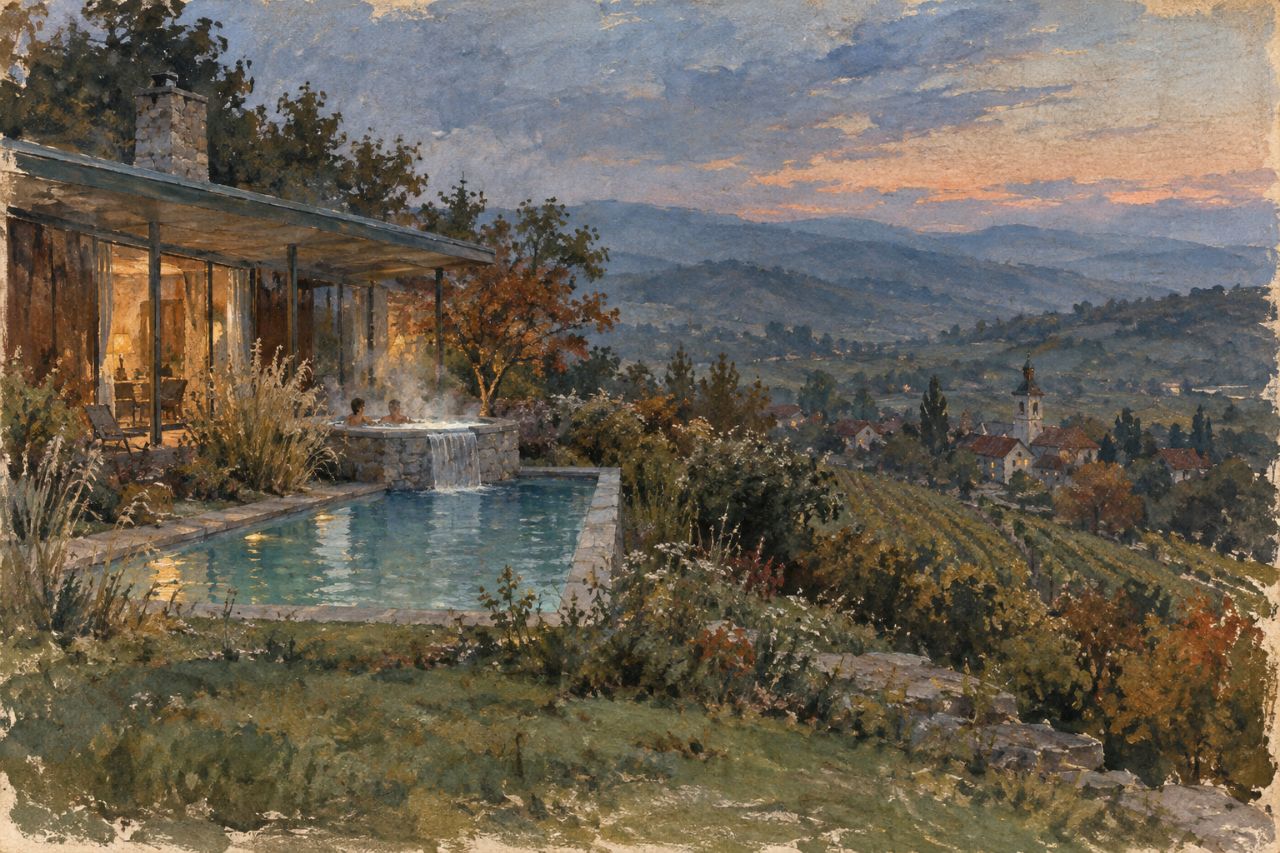
People say "pool and spa" and mean four different things. The first is the attached raised spa you see on concrete pools across Arizona, Texas and Florida: a round or square tub sitting a little above the pool, spilling a sheet of water over its lip into it. The second is a spa set into the deck at pool level, its rim flush with the paving, sharing a wall with the pool or standing a step away from it.
The third is a portable hot tub: a factory-made acrylic shell in a cabinet, delivered on a truck, set on a slab and wired in. The fourth is a swim spa, a long hot tub with a current strong enough to swim against in place, which some people buy instead of a pool rather than next to one.
They differ in price by a factor of five or more, and in what they ask of the pool build. The first two are part of the pool: dug with it, plumbed into it, run by the same equipment. The last two sit beside it and have their own everything. If nothing has been dug yet, this is the first decision to make, because an attached spa is structure and can't be added cheaply later.
The raised spillover spa, and the flush one
The spillover spa is the American default for good reasons. The raised wall, usually 11 3–17 3/4″ (30–45 cm) above the pool's water, gives you a ledge to sit on with your feet in the hot water, a little separation from the splashing, and the sound of falling water that people end up liking more than they expected. Because it shares the pool's pump, filter and heater, you're adding a basin and some valves, not a second equipment pad.
The spillover is also where the cost hides. The raised wall needs a finish on the outside (tile, stone veneer or the pool's own coping), and the lip has to be dead level or the sheet of water turns into a dribble at one corner. Spend time with the builder on that edge. It's the detail everyone looks at from the terrace.
Set flush with the deck instead, a spa looks calmer, suits a rectangular modern pool better, and is easier to step into from the terrace. You lose the waterfall and the sit-on wall. In Europe the flush version is the more common choice, sometimes reduced to a jetted bench inside the pool itself, partly for looks and partly because it's easier to keep warm.
Size, and how many people it really seats
A typical attached spa is 6′ 11″–7′ 10″ (2.1–2.4 m) across inside, square or round, with about 2′ 11″ (0.9 m) of water and a bench running around the edge. The seat sits roughly 17 3/4″–19 5/8″ (45–50 cm) below the surface, so the water reaches your shoulders when you lean back. That's around 793–1,057 gal (3–4 m³) of water, less than a tenth of a family pool.
Brochures call that size six to eight seats. Count it the way you'll use it: an adult needs about 23 5/8″–27 1/2″ (60–70 cm) of bench, knees don't fit into corners, and the entry step takes a stretch of wall. A 6′ 11″ (2.1 m) square comfortably holds four adults, five if they like each other. A 7′ 10″ (2.4 m) one holds six. Eight means children or a party.
Draw the benches, not just the outline. A spa with a bench on every side has a smaller footwell than you'd guess, and one reclining lounge seat takes the room of two upright ones. If you really want more than six, stepping up to 8′ 10″ (2.7 m) costs less than a second tub, but every size step is more water to heat each time you use it.
Build the spa twenty steps from the back door and you'll use it in summer. Build it five steps away and you'll use it in January.
Where it goes
Put the spa close to the house. It's the part you'll use in winter, at night, in a robe and slippers, and every metre of cold walk between the back door and the water counts against it. A pool can sit at the far end of the garden. A spa twenty steps from the door gets used half as often.
Then point it at something. You sit still in a spa for twenty minutes, so the view matters more there than anywhere in the pool: the garden, the sunset, the pool lit up after dark. Put it on the side where people sit anyway, next to the terrace, so whoever's in the spa is still part of the conversation.
Keep it out of the swim lane. A spa at the end of a lap pool turns the turning wall into a waterfall and the last few metres into a queue. The usual spot is a corner or the middle of a long side, near the shallow end so children can move between the two. PoolPlanner's designer doesn't draw a spa yet, so draw the pool and keep the spa's footprint clear on the deck beside it; that's enough to see that it fits and that the terrace still works around it.

Heating: small water, heated fast
An attached spa's whole appeal is that there's so little water in it. Lifting 1,057 gal (4 m³) by 15 degrees takes about 70 kWh of heat. A gas heater of the size US builders fit to pools, typically 273,000–409,000 BTU/h (80–120 kW), does that in about an hour. That's why the American pattern works: leave the spa at pool temperature, tap the controller on your phone before dinner, and it's at 38 °C when you're done eating.
In Europe the picture is different. A gas line to the garden is rare, so a spa is usually heated with electricity: the pool's heat pump, or a dedicated electric heater of 20,000–41,000 BTU/h (6–12 kW). At those outputs a cold spa takes several hours to come up, so European spas tend to be kept warm rather than heated on demand, which only makes sense under a good cover.
The cover matters more than the heater. Hot water loses most of its heat from the surface, and a bare spa at 38 °C on a cold night gives heat away far faster than the cooler pool beside it. A fitted, insulated cover saves more than any choice between gas and heat pump. Keeping a spa hot and uncovered is the most expensive way there is to own one.
Plumbing, valves and the spa mode
An attached spa runs on the pool's equipment through a set of valves. In pool mode, part of the returning water is sent to the spa and overflows back into the pool; that's the spillover you see. In spa mode the valves turn so the pump draws only from the spa and returns only to it, and the heater works on a few cubic metres instead of the whole pool. Motorized valves on the controller make that a button. Manual ones make it a walk to the equipment pad in the dark.
Jets need more pressure than the filter pump is built for, so a spa usually gets its own jet pump, and often an air blower for the bubbles. The blower pushes outdoor air through hot water: fun, and a fast way to cool the spa in winter. Place jets where your back and feet actually sit. Six to eight well-aimed jets beat twenty scattered ones.
Get the suction right. A small basin with strong suction is where hair and fingers can be caught, so the outlets need anti-entrapment covers and usually come in pairs rather than singly; your builder and local code set the details. Ask for the controls within reach of the house, and ask whether the spa can be heated while the pool stays unheated. It should be.
Safety: heat, children and a cover that locks
40 °C (104 °F) is the usual ceiling for a hot tub, and most controllers won't go past it. Most adults are happy between 37 and 39 °C for fifteen or twenty minutes. Alcohol and hot water are a bad pair, and pregnant women and anyone with a heart condition are generally told to ask their doctor first.
Children are the main thing to plan around. Small bodies heat up faster than adults', so young children should have short sessions at a lower temperature and never be in the spa alone. A spa is also deeper than it looks: 2′ 11″ (0.9 m) is over a toddler's head, and a raised spa wall is an easy thing to climb.
Budget a lockable cover from day one, especially if the spa sits right by the house. The pool barrier your building department requires still applies, and in some places a lockable safety cover is accepted as a hot tub's barrier, so check locally rather than assume. A cover that locks also keeps the heat in, which makes it the rare safety item that pays for itself.
What it adds to the budget, and the cheaper alternatives
An attached concrete spa is a small pool of its own: excavation, shell, finish, coping, plumbing, a jet pump, valves and often a bigger heater. On a US gunite pool it commonly adds somewhere around $15,000 to $35,000, more with a stone-clad raised wall or a long gas line, and a week or two to the schedule. A flush spa costs about the same underground; you only save the visible wall. Treat these as ranges to put to builders, not as quotes.
A good portable hot tub costs less, often $6,000 to $15,000 set on a slab, and it's usually better insulated than a built-in spa because the factory foams the whole cabinet. It won't match the pool, and a cabinet on the deck is harder to make look intentional, but it can arrive a year after the pool and leave with you when you move. A swim spa is a different idea again, often $20,000 to $50,000 or more, and worth a look mainly if you'd otherwise build no pool at all.
Before any of those, be honest about what you want the spa for. If it's lying in warm water in July, a tanning ledge gets you most of the way for a fraction of the price. If it's a longer season, a small heated plunge pool kept under a cover works most of the year. If it's jets and heat in January, a good hot tub does it best. The built-in spa earns its money when you want all of that beside a pool you already use, close enough to the house to walk there in a robe.
Before you add a spa to the plan
- Decide attached or separate before the pool layout is fixed; an attached spa is structure.
- Place it a short walk from the back door, facing the best view.
- Count seats by bench length, not by the brochure's number.
- Keep it out of the swim lane, ideally near the shallow end.
- Ask how the spa is heated and how long it takes to warm from cold.
- Put an insulated, lockable cover in the budget, not on a wish list.
- Ask for motorized valves and a spa mode that heats the spa alone.
- Check where the jets sit and whether there's a separate jet pump.
- Confirm the barrier and cover rules with your building department.
What goes wrong in practice
Believing the seat count
"Seats eight" is a count of bodies, not of comfortable adults. Plan on four in a 6′ 11″ (2.1 m) spa and six in a 7′ 10″ (2.4 m) one, and size up only if you regularly have more.
Putting the spa at the far end
It looks balanced on the drawing and goes unused from October to April. The spa belongs near the door and the terrace, even if that makes the plan less symmetrical.
Keeping it hot without a cover
A small, hot surface open to the night sky is where the heating bill comes from. Cover it every time, and let it drop back to pool temperature between uses if it heats fast enough.
Heating the pool through the spillover
Leave the spillover running while the spa is being heated and you're warming the pool through the back door. Heat in spa mode, with the spa isolated, and run the waterfall for looks when the heater's off.
Buying a spa for summer
Nobody sits in 38 °C water on an August afternoon. If summer is the season you care about, a tanning ledge or a shaded corner of the pool is the better spend.
Frequently asked questions
- How big should a spa attached to a pool be?
- Most are 6′ 11″–7′ 10″ (2.1–2.4 m) across inside, with about 2′ 11″ (0.9 m) of water and a bench all round. That comfortably seats four to six adults. Go bigger only if you regularly have more people, since every size step is more water to heat.
- What is a spillover spa?
- A spa built a little higher than the pool and joined to it, so its water spills over the lip into the pool in a sheet. It shares the pool's pump, filter and heater, and a set of valves switches between heating the spa alone and circulating both.
- Is a built-in spa better than a hot tub?
- A built-in spa matches the pool and shares its equipment; a good hot tub is cheaper, often better insulated, can be added later and moves house with you. If the pool is already built, or the budget is tight, the hot tub is usually the sensible choice.
- How long does it take to heat a pool spa?
- With a typical US gas pool heater, about an hour from pool temperature to 38 °C for a spa of 793–1,057 gal (3–4 m³). With a heat pump or small electric heater it's several hours, which is why those spas are usually kept warm under a cover.
- How much does it cost to add a spa to a pool?
- On a US concrete pool an attached spa commonly adds around $15,000 to $35,000, more with a stone-clad raised wall or a long gas line run. A good portable hot tub is often $6,000 to $15,000. Ask builders to price the spa as its own line.
- What temperature should a hot tub be?
- Most people settle between 37 and 39 °C (about 99 to 102 °F), and 40 °C (104 °F) is the usual maximum. Keep it lower and sessions shorter for children.
