Fiberglass vs concrete (gunite) pools
A factory-made shell or a pool built in place: install time, shape limits, upkeep and the 20-year cost compared.
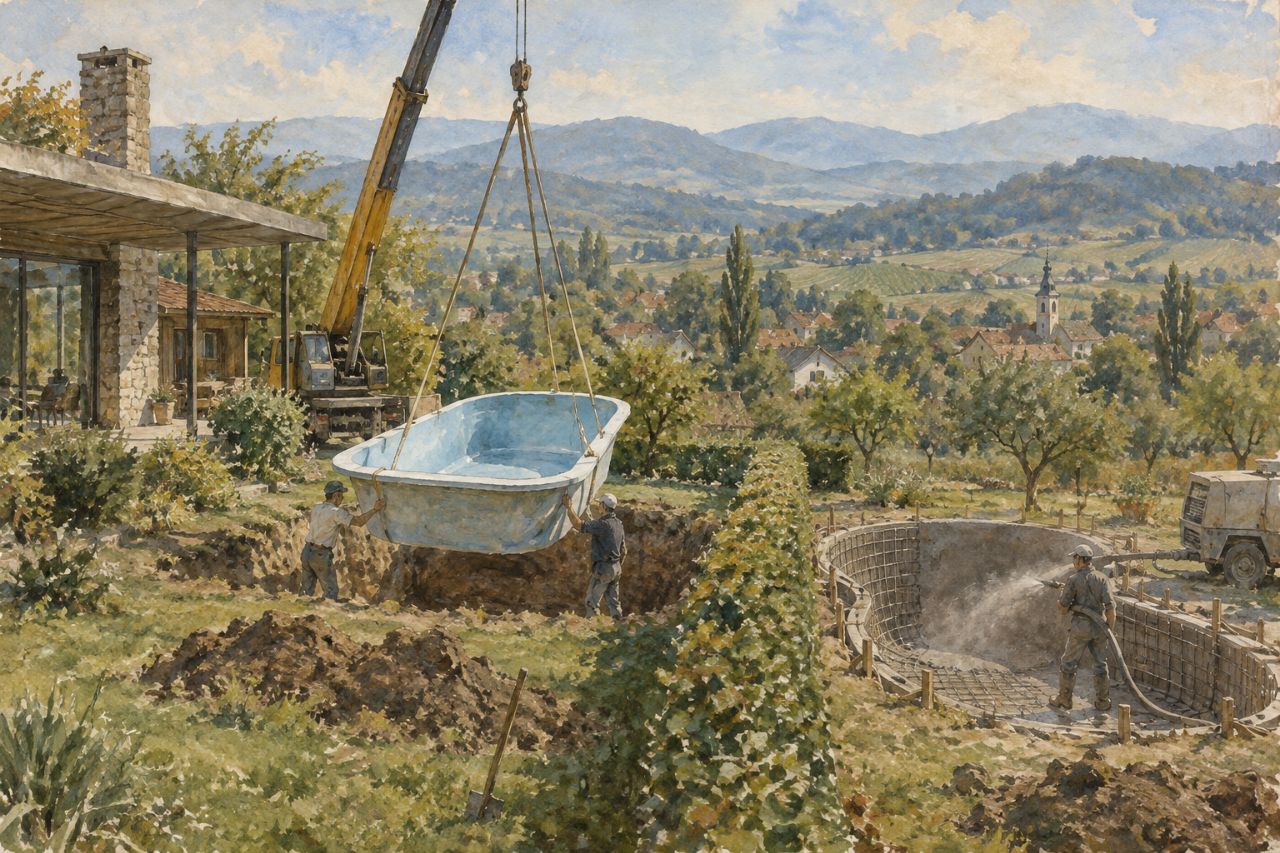
This is the first real fork in planning a pool, and it decides more than people expect. A fiberglass pool is a one-piece shell made in a factory, trucked to your street and lowered into a hole by crane. A concrete pool, which most American builders call gunite or shotcrete, is built in place: a steel cage in the excavation, concrete sprayed over it, then an interior finish of plaster, pebble or tile. Both hold water for decades. They differ in what you can draw, how long your garden is a building site, and when the bills arrive.
The short version: fiberglass trades freedom for speed and low upkeep, concrete trades time and maintenance for the pool you actually want. Neither is the premium choice by default. A well-installed fiberglass pool beats a badly built concrete one every day of the week, and the reverse is just as true.
- typical fiberglass install, dig to swim
- 1–3 wkstypical fiberglass install, dig to swim
- typical concrete build, dig to swim
- 2–4 mostypical concrete build, dig to swim
- plaster resurfacing rhythm on concrete
- 10–15 yrsplaster resurfacing rhythm on concrete
- a fiberglass shell, craned in whole
- 1 piecea fiberglass shell, craned in whole
At a glance
| Fiberglass | Concrete (gunite) | |
|---|---|---|
| How it's made | One shell, factory-moulded | Built in place by crews |
| Install time | 1–3 weeks | 2–4 months |
| Shape and size | Catalogue models, road-limited | Anything you can draw |
| Surface | Smooth, non-porous gelcoat | Plaster, pebble or tile |
| Upkeep | Low chemicals, easy to brush | More brushing and balancing |
| Renewal | Rarely; gelcoat refinish late | Resurface every 10–15 years |
| Upfront cost | Lower | Higher |
| Best for | Quick, standard family pools | Freeform, overflow edge, attached spa |
Made in a factory, or built in your garden
A fiberglass shell is laid up in a mould: a gelcoat surface sprayed first, then layers of glass fibre and resin behind it, cured indoors under controlled conditions. That's its quiet advantage. The shell you get is the shell that was designed, with the same wall thickness and the same curve as the hundred before it. Your installer's job is the hole, the base, the plumbing and the backfill, and that's where good and bad fiberglass pools part ways.
A concrete pool is made on your lot by a sequence of crews. Excavation, steel, plumbing, the shoot itself, curing, tile and coping, then the interior finish. Every step is a chance to do it well or cut a corner, and you're relying on the builder's supervision rather than a factory's. The upside is total: the shape, depth, steps and edges are whatever someone drew. I'd put it this way. With fiberglass you choose a product. With concrete you commission a structure.
How long your garden is a building site
Fiberglass is fast. Once the permit is in, a typical install runs one to three weeks from the first bucket of soil to water in the pool, and the shell itself goes in on a single morning. The catch is access for the delivery. A flatbed has to reach your street and a crane has to reach over the house or along the side yard, so overhead power lines, a narrow cul-de-sac or a steep drive can add cost or rule a model out. Check that before you fall for a catalogue picture.
Concrete takes two to four months in a normal build, longer if the weather or the crews don't cooperate. The shell needs weeks to cure before the finish goes on, and the finish itself needs careful start-up once filled. You'll live with a digger, a pump truck, rebound concrete on the lawn and a hole with a fence around it for most of a season. Plan the start so you're not losing the summer you built it for.
Groundwater changes the picture for both. A concrete shell is heavy, but a fiberglass shell is light, and an empty one sitting in waterlogged ground can be pushed upward, the pool popping out of its hole. Where the water table is high, a good installer adds a hydrostatic relief valve or a dewatering point and anchors the base properly. Ask about it on any lot near a creek, a lake or heavy clay.
Shape and size: the truck decides
Every fiberglass pool is a model from a manufacturer's range. The limit is road transport: shells rarely go beyond about 16′ 1″ (4.9 m) wide and 39′ 4″ (12 m) long, because anything bigger can't travel legally without an escort, if at all. Within that you'll find rectangles, freeforms, built-in benches, tanning ledges and a sensible depth range. What you won't find is your own curve, a pool that follows the property line, or the exact dimension your plot wants.
Concrete has no catalogue. Freeform shapes that hug a boulder, a vanishing or deck-level overflow edge, a spa attached with a spillover, a long lap lane, a beach entry, a deep end for a diving board where your code allows one: all of that is concrete territory. If you've drawn your pool at 26 × 13 ft (8 × 4 m) and it fits, fiberglass probably has a model close to it. If you've drawn something only your garden could hold, you've already chosen concrete.
Under your feet: surface, algae and chemicals
Gelcoat is smooth and non-porous. Algae find very little to hold onto, so the pool brushes clean easily, a robot cleaner does most of the work, and you'll typically use less chlorine and acid than you would with plaster. It's also gentle on skin and swimsuits. Steps and benches get a moulded non-slip texture; the floor is smooth and can feel a little slick, which some people like and some don't.
Plaster is cement, slightly rough and porous. That roughness gives grip and a natural look, but it also gives algae a foothold, and the cement reacts with your water: it pushes pH up, etches if the water runs aggressive, scales if it runs hard. Plaster pools want regular brushing and closer attention to water balance. A pebble finish is tougher and grippier; tile is the easiest of all but costs the most. Concrete's surface is a choice, fiberglass's is fixed.
Lifespan and what renewal means
Both shells can last for decades. What differs is what wears out on the way. A plaster interior on a concrete pool typically needs resurfacing every 10–15 years: drain it, chip or prepare the old surface, re-plaster, refill and rebalance. Pebble lasts longer, tile longer still. Plan on two or three resurfacings over the life of a plaster pool, each one a real bill and a lost week or two of summer.
Gelcoat doesn't need resurfacing on a schedule. Over many years it can fade, chalk or show small cosmetic blisters, and a shell can eventually be refinished, but a well-made one often goes twenty years or more without it. The rule that matters: never drain a fiberglass pool without asking the installer first. An empty shell is the most vulnerable it will ever be, both to groundwater and to walls bowing in with the backfill.
What it costs now, and over twenty years
Upfront, fiberglass usually comes in lower. As a broad 2026 picture in the US, a fiberglass pool installed with basic decking often lands somewhere around $50,000 to $90,000, while a comparable concrete pool typically starts around $70,000 and runs into six figures easily. Local prices swing a lot, and a crane lift, rock in the dig or a long access run can move either number.
Over twenty years the gap usually widens in fiberglass's favour. Concrete adds one or two resurfacings, commonly five figures each, plus more chemicals and more brushing or cleaner hours along the way. Fiberglass adds very little on the surface side. That doesn't make concrete a bad deal; it means you're paying for the design freedom twice, once at the build and again at each resurfacing. Put both in the budget before you compare the first quotes.
Choose fiberglass if… choose concrete if…
Choose fiberglass if you want to swim this summer rather than next, a standard shape and size genuinely fits your garden, you'd rather not babysit water chemistry, and the delivery truck and crane can reach the spot. It's the calm, practical choice for a family pool, and one of the models will likely be closer to what you'd have drawn than you expect.
Choose concrete if the shape is the point: a freeform, an overflow or vanishing edge, an attached spa, an unusual size or a pool that has to fit an awkward lot. Accept the longer build, the higher bill and the resurfacing rhythm as the price of that freedom. Either way, draw it to scale in the free designer first. If a catalogue shell fits your drawing, the choice gets much easier.
If a standard shell fits your garden and a crane can reach it, fiberglass is the calmer choice: faster to build, cheaper to own and easier to keep clean. If the shape is the point, whether that's a freeform, an overflow edge or a spa spilling into the pool, build it in concrete and budget for resurfacing from day one.
Frequently asked questions
- Is fiberglass or concrete better for a pool?
- Neither is better across the board. Fiberglass installs faster, costs less to own and is easier to keep clean; concrete can be any shape, size or edge detail. If a standard model fits your garden, fiberglass usually wins on cost and upkeep.
- How big can a fiberglass pool be?
- Most shells top out around 16′ 1″ (4.9 m) wide and 39′ 4″ (12 m) long, because that's roughly what can travel by road. Anything bigger or of a custom shape has to be built in concrete.
- Does a gunite pool need resurfacing?
- A plaster finish typically needs resurfacing every 10–15 years, sooner with poor water balance. Pebble and tile finishes last longer. The concrete shell underneath lasts for decades.
- Can you drain a fiberglass pool?
- Only with care, and ideally only with the installer's advice. An empty shell is light, and in high groundwater it can lift out of the ground or have its walls pushed in. Many repairs can be done with the pool partly full.
- Does a fiberglass pool use fewer chemicals?
- Usually, yes. Gelcoat is non-porous, so algae struggle to grip it and it doesn't push the pH up the way fresh plaster does. Expect less acid and chlorine and less brushing than with a plaster pool.

Go on — put a pool in your garden.
Open the designer and see it in 3D tonight. Free, no signup.
Start designing — it's freeFree · no signup · runs in your browser