Plunge pool vs hot tub
Plunge pool vs hot tub (or spa): cool dips or hot soaks? Water, temperature, build, buying and running costs, hygiene and the garden space each needs.
Zsolt Kocsmarszky · Updated
A plunge pool is a small pool you stand in and cool off in; a hot tub is a small tub you sit in and soak at 38 °C. The first is built into the ground and holds about 3,170 gal (12 m³) of water; the second arrives on a truck, holds 396–528 gal (1.5–2 m³) and sits on a slab.
So the question is rarely which is better, but which months you want to spend outside in water, and how warm. By hot tub we mean the free-standing acrylic tub with jets, an electric heater and an insulated lid. An attached spa built into a pool is a different project with its own guide, and a wood-fired tub is another thing again. The table gives the short version.
- of water in a 4 × 2.5 m plunge pool at 1.3 m, as its plan page computes it
- 11.7 m³of water in a 4 × 2.5 m plunge pool at 1.3 m, as its plan page computes it
- in a typical five- or six-seat hot tub
- 1.5–2 m³in a typical five- or six-seat hot tub
- where most hot tubs are kept; 40 °C (104 °F) is the usual ceiling
- 38 °Cwhere most hot tubs are kept; 40 °C (104 °F) is the usual ceiling
- between a hot tub's drain and refill, as most makers advise
- 3–4 monthsbetween a hot tub's drain and refill, as most makers advise
At a glance
| Plunge pool | Hot tub | |
|---|---|---|
| What it's for | Cooling off, floating, cold dips | Hot soaking and jet massage |
| Water | About 12 m³, 1.2–1.4 m deep | 1.5–2 m³, about 0.9 m deep |
| Temperature | 26–30 °C in summer, 10–15 °C as a cold plunge | 37–40 °C, all year |
| How you use it | Stand, float, sit on a bench | Sit in moulded seats, 4–5 adults |
| Build | Dug and built in place: days to weeks | Delivered whole: a day on a ready slab |
| To buy | Two to five times a good hot tub | Often 6,000–15,000 in € or $ |
| To run | Cheap warm in summer, dear hot in winter | Steady all year, most of it in winter |
| Water care | Pool routine in small doses, rarely drained | Stricter sanitising, refill every 3–4 months |
| Lifespan | Shell lasts decades, parts renewed | Typically 10–15 years |
| Garden it needs | 20–25 m² with deck, plus plant and digger access | 6–8 m² and a clear delivery path |
Plunge pool or hot tub: which one do you actually want?
If you want to cool off in summer, stand chest-deep, float and take cold dips in winter, you want a plunge pool: about 3,170 gal (12 m³) of water at a single depth of 3′ 11″–4′ 7″ (1.2–1.4 m), at its best between 26 and 30 °C. If you want to sit in hot water with jets on your back on a cold night, you want a hot tub: 396–528 gal (1.5–2 m³) at 37–40 °C, under a lid that keeps the heat in between uses.
They overlap only in the warm middle. A plunge pool held at 32–34 °C under a cover is lovely in October and March, and a hot tub turned down is pleasant on a June evening. A plunge pool kept at 38 °C through a frost is an expensive way to own a hot tub, and a hot tub cannot make cold water at all. Decide which end of the thermometer you care about, and most of what follows falls into place.
Water, temperature and how you sit in each
A 13 × 8 ft (4 × 2.5 m) plunge pool at 4′ 3″ (1.3 m) holds six to eight times the water of a hot tub, and you use it standing. Push off a wall and float, take three strokes, or sit on a bench along one wall about 15 3/4–17 3/4″ (40–45 cm) below the surface. Four adults fit with room to move past each other. Most visits are short: a minute or two to cool off between spells of sun.
A hot tub is about 7 × 7 ft (2.2 × 2.2 m) outside and 2′ 11″ (0.9 m) deep at the footwell, and everything in it is a seat: moulded chairs, often one lounger, jets where backs and feet go. Brochures count five to seven places; four or five adults sit in comfort, and nobody stands. You stay fifteen or twenty minutes at 37–39 °C. That heat is the point and the price: it loosens a back the way 30 °C water never will, and it is too hot to enjoy on a summer afternoon.
Through the year: summer dips, winter soaks and cold plunges
The two are busiest in opposite seasons. A plunge pool earns its keep from May to September and, with a cover and a heat pump, stretches into April and October at around 30 °C. A hot tub is used all year but comes into its own from October to March, when steam rises off it and the walk from the back door in a robe is the best part of the evening.
Cold plunging belongs to the plunge pool. Left to the season, its water falls to 10–15 °C in late autumn and lower in midwinter, needing only the pump running on frost nights, as in the active wintering of any pool; cold water in July takes a chiller or a reversible heat pump. A hot tub cannot be a cold plunge in any season: with the heater off it drifts to the temperature of the day, and its pumps nudge it warmer.
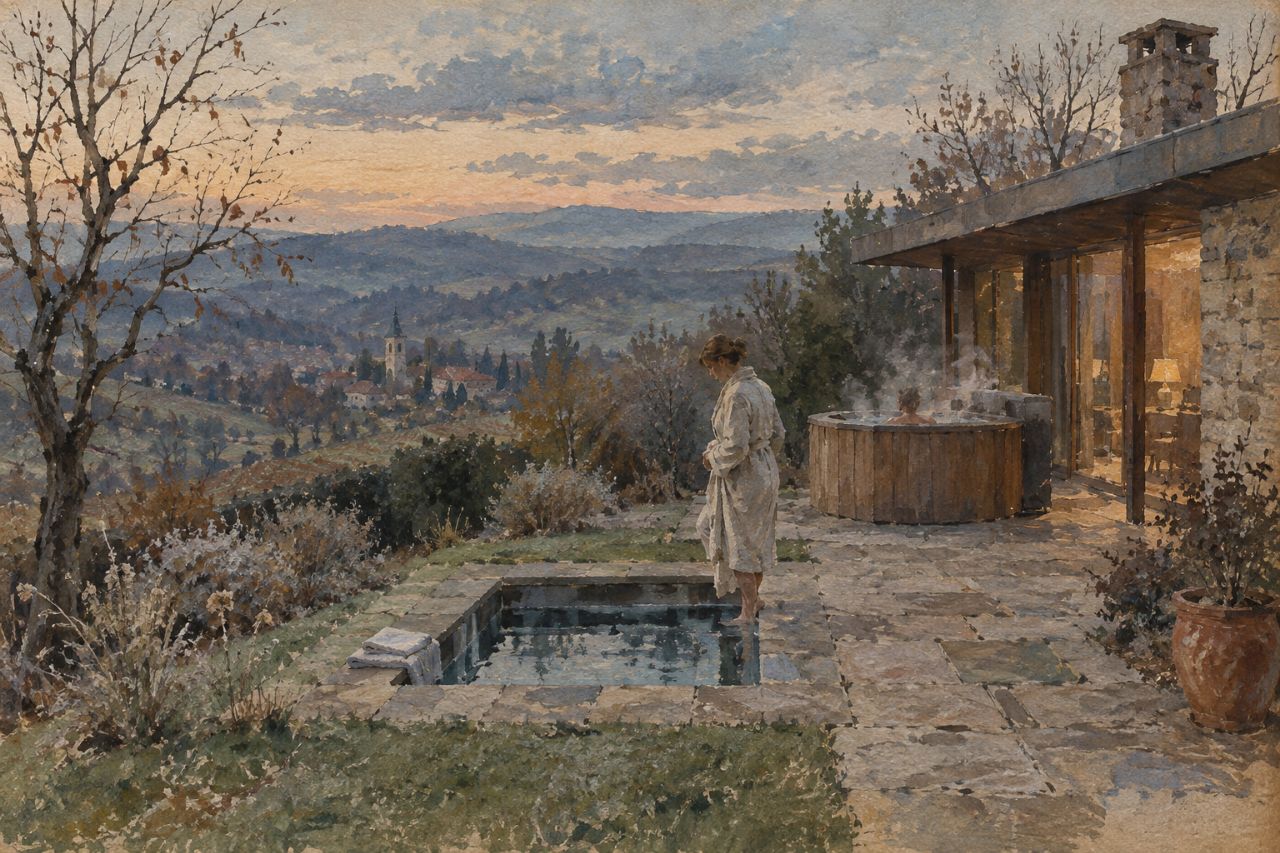
If you are after hot and cold, sauna-style, that is two things: a plunge pool beside a hot tub, or a small cold-plunge tub next to one where a pool won't fit. One basin cannot be 38 °C and 8 °C on the same evening.
Building one, delivering the other
A plunge pool is a pool: dug, built and plumbed in place, with roughly 5,283–7,925 gal (20–30 m³) of soil out for a 13 × 8 ft (4 × 2.5 m) pool, a one-piece fiberglass shell craned in or a liner or concrete shell built on site, then coping, deck, filter, heat pump and cover. A one-piece shell can be running within days to a couple of weeks of the dig and tiled concrete takes weeks, after the same months of quotes and paperwork as a family pool. Filling from a garden tap takes about eight hours, the first warm-up two or three days.
A hot tub is an appliance. It stands on the level base its maker specifies, usually a concrete slab, since full of water and people it weighs more than two tonnes, and needs its own circuit with residual-current protection, put in by an electrician. Delivered, it is in place in an hour or two, full in another and hot by the next evening; the slab and the electrician take the time, a week or two from bare lawn. It travels on its side, as thick as its cabinet is tall, so the route needs a clear path a little over 3′ 3″ (1 m) wide, or a crane.
Permits split the same way: most building authorities want to hear about an in-ground pool, though some exempt small ones, while a hot tub usually counts as an appliance apart from its electrics. Both are deep enough to drown a toddler, so plan the pool barrier or a locking lid from day one, and check the local rules rather than assume.
In the garden, a plunge pool takes 215–269 sq ft (20–25 m²) with coping and a metre of deck where you step in, plus the plant and a way in for a digger; a hot tub takes 65–86 sq ft (6–8 m²) with room for its lid to fold back. Draw a 13 × 8 ft (4 × 2.5 m) plunge pool in the designer at a single depth of 4′ 3″ (1.3 m) to read its volume and a live cost estimate; it doesn't draw a hot tub, so keep a 8 × 8 ft (2.4 × 2.4 m) square of deck clear beside it.
What each costs to buy, and how long it lasts
The plunge pool is the bigger purchase. The plunge sizes in the plan library put a 13 × 8 ft (4 × 2.5 m) pool at roughly €15,000–25,000 as a one-piece fiberglass shell, €18,000–30,000 with a liner and €27,000–43,000 in tiled concrete, and the American 8x16 at $26,000–40,000 in vinyl, $34,000–48,000 in fiberglass and $44,000–66,000 in gunite. That covers the dig, the shell, basic equipment and coping; the deck, fencing, permits, the heat pump and the cover come on top.
A good hot tub is often 6,000–15,000 in euros or dollars, set in place, heater, pumps, jets and insulated lid included; add the slab and the electrician if the dealer doesn't. Compare the middles and the plunge pool costs two to five times as much before it is heated, because anything built on site carries a fixed floor of groundworks, plumbing and trades.
Lifespans run the other way. A plunge pool's shell is built to last decades, and what wears is renewed on its own schedule: a liner every 8–12 years, plaster every 10–15, the pump and heat pump when they give out. A well-made hot tub typically lasts 10 to 15 years, with a pump or control board replaced along the way and a new lid every few years. When you sell, the plunge pool stays and is judged like any pool, on condition and running cost; the hot tub can leave with you, though an old one is worth little.
What each costs to run: the heat-loss arithmetic
Running cost is mostly heat, and heat is arithmetic: 1.16 kWh warms a cubic metre of water by one degree. A fresh 396 gal (1.5 m³) fill taken from 12 to 38 °C needs about 45 kWh, and the tub's electric element, typically 10,000 BTU/h (3 kW), turns each kWh it draws into one of heat: 45 kWh off the meter, over some fifteen hours. Taking 3,170 gal (12 m³) of plunge pool from 12 to 30 °C needs about 250 kWh, but a heat pump in mild air gives four to six units of heat per unit drawn, so the meter shows 40–65 kWh. The first warm-up costs much the same.
Holding the temperature is where they part. A well-built hot tub, a foam-filled box with a thick lid, loses something like 5–10 watts for each degree between water and air; a plunge pool, with 108 sq ft (10 m²) of water under a slatted cover and some 291 sq ft (27 m²) of concrete against cold earth, something like 60–90. On a 2 °C night that is 4–9 kWh a day to keep the hot tub at 38 °C, and 45–65 kWh of heat to keep the plunge pool at 32 °C, which a heat pump in that cold delivers at two or three units per unit, if it runs at all: 15–30 kWh from the meter, three or four times the hot tub.
Summer turns the sums round: a covered plunge pool at 26–28 °C needs little heat from June to August, while a hot tub at 38 °C is still fifteen degrees warmer than the night air. Used for what each does best, the plunge pool warm from May to September and cold after, the hot tub hot all year, they land closer than you might expect: roughly 1,000–2,000 kWh a year for the plunge pool, split between filter pump and heat pump, and 1,500–3,000 for the hot tub, mostly in winter. These are rough sums for a temperate climate, with the cover on whenever nobody is in the water. Multiply by your own tariff.
Keeping the water clean: why a hot tub needs stricter care
Hygiene is the hot tub's hard part, because of concentration. Four adults in 396 gal (1.5 m³) is one person to every 106 gal (0.4 m³); in a plunge pool they have 793 gal (3 m³) each. At 38 °C everyone sweats, and sweat, skin oils and sunscreen go into a small, warm volume where bacteria grow fast. Warm water and the fine spray from jets are also what Legionella bacteria favour, so hot-tub care is stricter than pool care, not a smaller copy of it.
Keep the sanitiser at the maker's level, usually higher than a pool's, and test it two or three times a week; many owners use bromine, which holds up better than chlorine in hot water. Rinse the filter cartridges every week or two and replace them every year or two. Drain, clean and refill every three or four months, as most makers advise, sooner with heavy use: cheap in water, but every fresh fill is heated from cold.
A plunge pool is looked after like any pool, with a sand or cartridge filter and the usual water chemistry in smaller doses: halve a scoop meant for a family pool and test more often. Above 30 °C it starts to burn chlorine and grow algae like a hot tub, so filter longer as it warms. It is never routinely drained.
Choose a plunge pool if… choose a hot tub if…
Choose a plunge pool if summer is your season, if you want to stand, float and cool off rather than sit, if cold dips in winter appeal, and if the garden has 215–269 sq ft (20–25 m²) to give and a way in for a digger. Budget for it as the small pool it is, with the heat pump and the cover in the first quote.
Choose a hot tub if you want heat, jets and long evenings outside from October to March, if the budget is a fraction of a pool's, if you may move house, or if the garden is small. Put it a few steps from the back door. And if what you really want is to swim, choose neither: that is a lap pool or a swim spa, and another comparison.
For summer cooling, floating and cold dips in winter, build the plunge pool, and budget for it as the small pool it is. For hot soaks and jets on winter evenings, buy the hot tub: it costs a fraction as much, arrives finished and holds 38 °C on far less energy than any pool can. Want both? That is two things, not one compromise.
Frequently asked questions
- Is a plunge pool or a hot tub cheaper?
- To buy, the hot tub by a wide margin: often 6,000–15,000 in euros or dollars, against two to five times that for a plunge pool. Over a year of each doing its own job, the running costs land in a similar range.
- Can a plunge pool be heated like a hot tub?
- To 32–34 °C under a cover, yes, which is lovely in spring and autumn. Holding 38 °C through a winter takes three or four times the hot tub's energy, because the pool loses heat through more surface and bare concrete.
- Can I use a hot tub as a cold plunge?
- Not really: with the heater off it settles near the air temperature, and its pumps add a little warmth. A plunge pool goes cold by itself in winter, and a cold-plunge tub with its own chiller is the compact alternative.
- How often do you change the water in a hot tub?
- Most makers advise draining, cleaning and refilling every three or four months, sooner with heavy use. A plunge pool is never routinely drained; its filter and water chemistry keep it clean like any pool.
- Do I need a permit for a plunge pool or a hot tub?
- Most building authorities want to hear about a plunge pool, as an in-ground pool, though some exempt small ones. A hot tub is usually treated as an appliance, but rules on its electrics and often on child safety still apply. Check with your local authority.
- Is a swim spa a plunge pool and a hot tub in one?
- Partly. A swim spa is a 13′ 1″–19′ 8″ (4–6 m) heated tub with a counter-current, run warm for swimming or hot as a spa, one at a time. At often 20,000–50,000 in euros or dollars it costs far more than a hot tub and as much as a plunge pool or more, and it suits a garden that would otherwise have no pool at all.

Go on — put a pool in your garden.
Open the designer and see it in 3D tonight. Free, no signup.
Start designing — it's freeFree · no signup · runs in your browser