- Europe's most-built family size: 32 m² of water
- 8 × 4 mEurope's most-built family size: 32 m² of water
- the classic US size: 4.88 m (16 ft) wide, 9.75 m (32 ft) long
- 16x32the classic US size: 4.88 m (16 ft) wide, 9.75 m (32 ft) long
- the proportion most standard rectangles share
- 2:1the proportion most standard rectangles share
- surface and water, going from 8 × 4 to 10 × 5 m
- +56%surface and water, going from 8 × 4 to 10 × 5 m
What are the standard pool sizes?
In Europe most private pools are one of about a dozen rectangles, written length first, in metres: 13 × 8 ft (4 × 2.5 m) and 16 × 8 ft (5 × 2.5 m) as plunge pools, 16 × 10 ft (5 × 3 m) and 20 × 10 ft (6 × 3 m) as compact ones, 23 × 11 ft (7 × 3.5 m), 26 × 13 ft (8 × 4 m), 30 × 13 ft (9 × 4 m) and 33 × 16 ft (10 × 5 m) as family pools, 39 × 20 ft (12 × 6 m) and up as large ones. In the United States the list is in feet and written width first — 12x24, 14x28, 16x32, 18x36, 20x40 — with the 16x32 as the classic family pool.
Nobody publishes these as a standard; why they became one is further down. Most of them share one proportion, twice as long as they are wide: long enough for a few strokes, wide enough for two people to pass, with room for a shallow end and a deep end in line.
The table below gives a dozen of them from the plan library, each with its class's depths and its surface and volume computed from the plan's own outline.
Standard metric pool sizes: depth, surface and water
| Pool | Depth | Water surface | Water volume |
|---|---|---|---|
| 4 × 2.5 m Rectangular | 4′ 3″ | 108 sq ft | 3,091 gal |
| Ø 3.5 m Round | 4′ 3″ | 103 sq ft | 2,964 gal |
| 6 × 3 m Rectangular | 3′ 11″–5′ 3″ | 194 sq ft | 6,035 gal |
| 6 × 3 m Roman | 3′ 11″–5′ 3″ | 173 sq ft | 5,357 gal |
| 7 × 4 m Kidney | 3′ 11″–5′ 11″ | 171 sq ft | 5,826 gal |
| Ø 5 m Round | 3′ 11″–5′ 11″ | 211 sq ft | 7,163 gal |
| 7 × 3.5 m Rectangular | 3′ 11″–5′ 11″ | 264 sq ft | 8,859 gal |
| 8 × 4 m Oval | 3′ 11″–5′ 11″ | 270 sq ft | 9,050 gal |
| 8 × 4 m Rectangular | 3′ 11″–5′ 11″ | 344 sq ft | 11,571 gal |
| 10 × 5 m Rectangular | 3′ 11″–5′ 11″ | 538 sq ft | 18,080 gal |
| 12 × 4 m Rectangular | 4′ 5″ | 517 sq ft | 15,470 gal |
| 12 × 6 m Rectangular | 3′ 11″–6′ 7″ | 775 sq ft | 27,930 gal |
The five size classes and their dimensions
The plan library sorts each size into a class by its length times its width, and gives each class its depths. A plunge pool is up to about 140 sq ft (13 m²): 10 × 7 ft (3 × 2 m) to 16 × 8 ft (5 × 2.5 m), or a circle of 9′ 10″–11′ 6″ (3–3.5 m), at one depth of 4′ 3″ (1.3 m). A compact pool runs to about 258 sq ft (24 m²) — 16 × 10 ft (5 × 3 m) to 23 × 10 ft (7 × 3 m) — at 3′ 11″ (1.2 m) sloping to 5′ 3″ (1.6 m).
A family pool covers 258–538 sq ft (24 to 50 m²): 23 × 11 ft (7 × 3.5 m) to 33 × 16 ft (10 × 5 m), at 3′ 11″ (1.2 m) shallow to 5′ 11″ (1.8 m) deep, and that one class already spans from about 8,982–17,964 gal (34 to 68 m³) of water. Above 538 sq ft (50 m²) the library calls it an estate pool — 36 × 16 ft (11 × 5 m), 39 × 20 ft (12 × 6 m), 46 × 20 ft (14 × 6 m) — with a deep end of 6′ 7″ (2 m). The lap pool is a class of its own: at least 39′ 4″ (12 m) long, no more than 13′ 1″ (4 m) wide, at one depth of 4′ 5″ (1.35 m); 39 × 13 ft (12 × 4 m), 49 × 13 ft (15 × 4 m) and 59 × 13 ft (18 × 4 m) are the classic formats, and in America the 10x40 and 12x40. Which class suits your household is the subject of the guide on how big your pool should be.
Why 8 × 4 and 10 × 5 m? What makes a size standard
No standards body fixed these sizes. They became standard because many parts of a pool are made before your pool exists, in a short list of sizes. Kit pools — steel walls, bolted panels or concrete-filled polystyrene blocks — come in whole and half metres, with liners and covers to match. A fiberglass shell is cast in a mould that is expensive to make, so each maker offers a dozen or so sizes, and the road sets the ceiling: roughly 16′ 1″ (4.9 m) wide and around 39′ 4″ (12 m) long, beyond which it needs a road permit and an escort.
Reinforcing steel is sometimes given as a reason, and it isn't one: bars are cut and lapped on site to whatever the drawing says, and concrete takes any outline at much the same price per metre of wall. So a standard size saves money exactly where a part is bought rather than built — a kit, a shell, a stock liner or winter cover, and every replacement of them. In a concrete pool with a made-to-measure cover, a 25 × 12 ft (7.6 × 3.8 m) costs what its square metres cost, and there is no reason to bend the garden to fit an 26 × 13 ft (8 × 4 m). Habit does the rest: brochures start from the same few sizes, so people ask for them.
A pool's name is the box it fits in, not the water it holds: a kidney and a rectangle both sold as a 16x32 differ by more than 40% in surface.
16x32 and 18x36: the American sizes, width first
An American size is written width first, in feet: a 16x32 is 16′ (4.88 m) wide and 32′ (9.75 m) long. Europe writes length first, so the same pair of numbers reads the other way round on each side of the Atlantic — harmless on a drawing, and exactly how an order for a cover or a liner turns a pool through ninety degrees. Write both numbers with their unit, and say which one is the length.
Each rung keeps the 2:1 shape, from the 12x24 to the 20x40. Vinyl-liner kits are sold in these sizes, with liners and safety covers to match, and the fiberglass road limit of about 16′ 1″ (4.9 m) matches the width of a 16x32. There is no American 26 × 13 ft (8 × 4 m): a 12x24 is close to a 23 × 11 ft (7 × 3.5 m), a 14x28 has about 14% more surface than an 26 × 13 ft (8 × 4 m), a 16x32 is the near twin of a 33 × 16 ft (10 × 5 m), and a 20x40 of a 39 × 20 ft (12 × 6 m). The table below gives the American ladder with the same computed figures, none of them with a diving well.
Standard US pool sizes: depth, surface and water
| Pool | Depth | Water surface | Water volume |
|---|---|---|---|
| 12 × 24 ft Rectangular | 3′ 11″–5′ 11″ | 288 sq ft | 9,675 gal |
| 14 × 28 ft Rectangular | 3′ 11″–5′ 11″ | 392 sq ft | 13,169 gal |
| 16 × 32 ft Rectangular | 3′ 11″–5′ 11″ | 512 sq ft | 17,200 gal |
| 18 × 36 ft Rectangular | 3′ 11″–6′ 7″ | 648 sq ft | 23,353 gal |
| 20 × 40 ft Rectangular | 3′ 11″–6′ 7″ | 800 sq ft | 28,831 gal |
| 10 × 40 ft Rectangular | 4′ 5″ | 400 sq ft | 11,977 gal |
| Ø 18 ft Round | 3′ 11″–5′ 11″ | 254 sq ft | 8,576 gal |
| 16 × 32 ft Kidney | 3′ 11″–5′ 11″ | 291 sq ft | 9,902 gal |

Round, oval and kidney pools: what the size leaves out
A round pool is named by its diameter. Metric sizes step in half metres from 9′ 10″ (3 m) to about 19′ 8″ (6 m); American ones step by 3′ (0.9 m), from 12′ (3.66 m) to 24′ (7.32 m), the diameters above-ground pools are sold in — which is why many frame pools in European garden centres measure 12′ (3.66 m), 15′ (4.57 m) or 18′ (5.49 m). A circle covers about 78% of the square around it: a 11′ 6″ (3.5 m) round pool has 103 sq ft (9.6 m²) of water, a 16′ 5″ (5 m) one 211 sq ft (19.6 m²).
Ovals and kidneys are named by the rectangle they fit in, and that is where comparisons go wrong. An 26 × 13 ft (8 × 4 m) oval has 269 sq ft (25 m²) of water, 78% of the rectangle's 344 sq ft (32 m²). The 23 × 13 ft (7 × 4 m) kidney in the table has just under 172 sq ft (16 m²), and a 16x32 kidney about 291 sq ft (27 m²) against the rectangle's 517 sq ft (48 m²) — little more than half. European ovals are mostly steel-walled kits that follow the kit lists, and kidney outlines differ from maker to maker. Compare curved pools in square and cubic metres, never by the name.
Roman-end pools: the sizes, and what a 6 × 3 m Roman holds
A Roman pool, as this site draws it, is a rectangle with a half circle at each end, as wide as the pool, and the length includes both ends. A 20 × 10 ft (6 × 3 m) Roman is therefore a 9′ 10″ (3 m) straight middle between two half circles: about 172 sq ft (16 m²) of water instead of the rectangle's 194 sq ft (18 m²), and about 5,283 gal (20 m³) at 3′ 11″ (1.2 m) sloping to 5′ 3″ (1.6 m). At the usual 2:1 proportion a Roman keeps about 89% of the rectangle's surface, whatever its size.
The standard Roman sizes follow the rectangles: 20 × 10 ft (6 × 3 m), 23 × 11 ft (7 × 3.5 m), 26 × 13 ft (8 × 4 m), 33 × 15 ft (10 × 4.5 m) and 39 × 20 ft (12 × 6 m) in Europe, the 14x28 to the 20x40 in America. The name also covers a plain rectangle with a curved bay of Roman steps added at one end; there, ask whether the stated length includes the bay, which can add a metre or more to the hole. Either way, set the shape in the designer — the Roman is one of its ten — put Roman steps in the curved end, and read the volume it reports.
Standard pool depths, and why the water is lower than the number
The depths follow the classes: 3′ 11″ (1.2 m) shallow to 5′ 11″ (1.8 m) deep for a family pool, one depth of about 4′ 3″ (1.3 m) for a plunge pool and 4′ 5″ (1.35 m) for a lap pool. Kit pools often have one depth set by their wall height, commonly 3′ 11″ (1.2 m) or 4′ 11″ (1.5 m). None of these is a diving pool: a head-first dive needs at least 7′ 10″ (2.4 m) of water over a much larger area, and the guide to pool depth explains why.
Check what a depth is measured from. Here, as in the designer, depths run down from the deck, and on a skimmer pool the water stands about 5 1/8″ (13 cm) lower. That is why the tables give an 26 × 13 ft (8 × 4 m) at 3′ 11″ (1.2 m) to 5′ 11″ (1.8 m) about 11,624 gal (44 m³), where surface times average depth says 12,680 gal (48 m³): the second figure is the shell, the first is the water you fill, heat and treat.
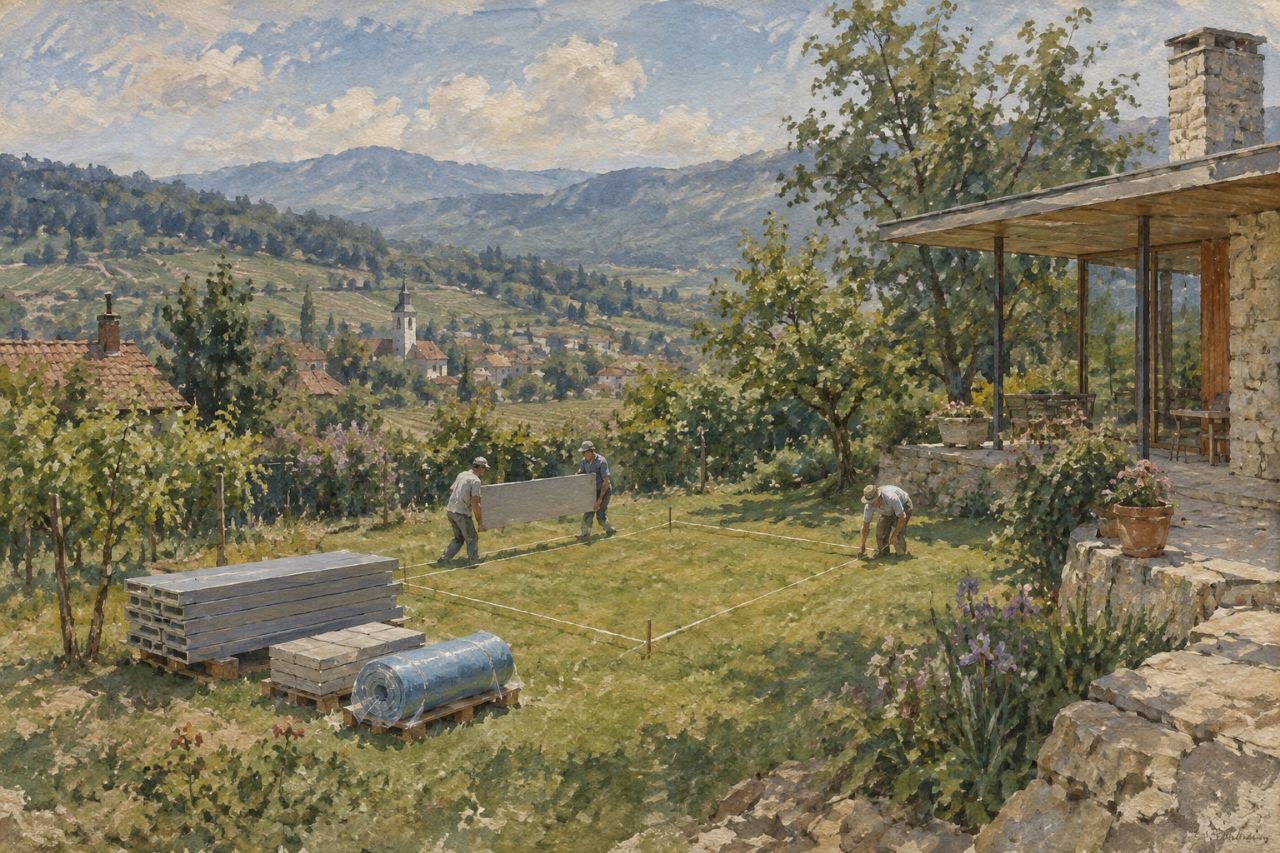
The footprint around the water, size by size
Around the water go the coping, about 13 3/4″ (35 cm) of stone; a walk-around of at least 23 5/8″ (60 cm), nearer 3′ 3″ (1 m) where people pass; and on one side room for loungers, at least 6′ 7″ (2 m). Below ground the hole is wider again by the walls, typically 5 7/8–11 3/4″ (15–30 cm) a side, plus working room. For a first sketch, add about 9′ 10″ (3 m) to each dimension of the water.
So a 13 × 8 ft (4 × 2.5 m) plunge pool claims about 23 × 18 ft (7 × 5.5 m), an 26 × 13 ft (8 × 4 m) about 36 × 23 ft (11 × 7 m), a 33 × 16 ft (10 × 5 m) about 43 × 26 ft (13 × 8 m) and a 16x32 about 42 × 26 ft (12.8 × 7.9 m). The plunge pool's zone is nearly four times its water, the 33 × 16 ft (10 × 5 m)'s about twice: the surround hardly shrinks with the pool. Setbacks, the plant room and the excavator's route come on top, and the guide on what size pool fits your yard works through them.
How surface and water grow with each step up
Size names hide how fast pools grow. Make both sides a quarter longer and the surface grows by more than half: 26 × 13 ft (8 × 4 m) to 33 × 16 ft (10 × 5 m) takes it from 344–538 sq ft (32 to 50 m²) and the water from about 11,624–17,964 gal (44 to 68 m³), 56% more of each. Double both sides and you get four times the surface and 4.6 times the water — a 39 × 20 ft (12 × 6 m) against a 20 × 10 ft (6 × 3 m) — because bigger pools are also built deeper. On the American ladder, going from the 16x32 to the 18x36 adds about a quarter to the surface and over a third to the water, from about 17,171–23,247 gal (65 to 88 m³).
Everything that follows the water follows these steps: a garden tap fills an 26 × 13 ft (8 × 4 m) in about 29 hours and a 33 × 16 ft (10 × 5 m) in about 46, and the heat pump and chemicals scale alike. For a quick estimate, multiply the surface by the average depth and take off the gap to the deck; for the exact figure, see the guide to how much water a pool holds. Every size in the tables is also a page in the plan library, drawn to scale, with its skimmers, heat pump, fill time and cost range.
Before you settle on a size
- Write every size as length × width with its unit, and check which way round a US quote reads.
- Ask whether a stated size is the water, the inside of the walls or the outside of the shell.
- Compare quotes in square metres of surface and cubic metres of water, not by the size's name.
- For a Roman or a kidney, ask whether the size includes the curved end or the step bay.
- Kit, kit liner or one-piece shell: pick a standard size. Concrete: build the size the garden wants.
- Check what the depths are measured from; on a skimmer pool the water is about 13 cm below the deck.
- Add about 3 m to each dimension of the water for coping, a walk-around and loungers.
- Before going up a size, compare the volumes: 8 × 4 to 10 × 5 m is 56% more water.
What goes wrong in practice
Reading a US size the European way round
A 16x32 gives the width first. An order for a cover or a liner that swaps the two numbers is an order for a different pool, so spell out which one is the length on anything you sign.
Comparing curved pools by their names
An 26 × 13 ft (8 × 4 m) oval has about four fifths of the rectangle's surface, and a kidney of the same name little more than half. Compare square and cubic metres, or you are comparing prices for different amounts of pool.
Squeezing a concrete pool into a kit size
A concrete shell is built for your garden alone, so trimming 11 3/4″ (30 cm) off a good layout to hit 26 × 13 ft (8 × 4 m) saves nothing. Check instead that the cover you want can be had to fit.
Taking the depth on the drawing for the water
On a skimmer pool the water stands about 5 1/8″ (13 cm) below the deck the depths are measured from, so a 3′ 11″ (1.2 m) shallow end holds nearer 3′ 6″ (1.07 m) of water — which matters when its whole point is a child's standing depth.
Moving up a size because it sounds small
From 26 × 13 ft (8 × 4 m) to 33 × 16 ft (10 × 5 m) sounds like a metre each way. It is 56% more surface to cover and heat, and about 6,604 gal (25 m³) more water, every year the pool exists. Look at the volume before the name.
Frequently asked questions
- What is the most common pool size?
- In Europe the 26 × 13 ft (8 × 4 m) rectangle, with the 33 × 16 ft (10 × 5 m) as the usual step up; in the United States the classic 16x32, about 32 × 16 ft (9.75 × 4.88 m). Both are twice as long as they are wide.
- What is the average pool size?
- There is no reliable published average, but the middle of both ladders is a family pool of about 323–538 sq ft (30–50 m²) of water: an 26 × 13 ft (8 × 4 m) has 344 sq ft (32 m²), a 16x32 about 517 sq ft (48 m²).
- How big is a 33 × 16 ft (10 × 5 m) pool?
- 538 sq ft (50 m²) of water, holding about 17,964 gal (68 m³) at 3′ 11″ (1.2 m) shallow to 5′ 11″ (1.8 m) deep. With coping, a walk-around and room for loungers it claims a zone of about 43 × 26 ft (13 × 8 m) in the garden.
- How big is a 20 × 10 ft (6 × 3 m) Roman pool?
- With a half circle at each end, about 172 sq ft (16 m²) of water and 5,283 gal (20 m³) at 3′ 11″ (1.2 m) sloping to 5′ 3″ (1.6 m): nine tenths of the rectangle. If the Roman part is a bay of steps added to a rectangle, ask whether the 19′ 8″ (6 m) includes it.
- Is a 16x32 pool the same as an 26 × 13 ft (8 × 4 m) pool?
- No. A 16x32 is 16′ (4.88 m) wide and 32′ (9.75 m) long, about 517 sq ft (48 m²) of water: the near twin of a 33 × 16 ft (10 × 5 m). An 26 × 13 ft (8 × 4 m) falls between the American 12x24 and 14x28.
- What is the standard depth of a pool?
- For a family pool, 3′ 11″ (1.2 m) at the shallow end and 5′ 11″ (1.8 m) at the deep end; for a plunge pool about 4′ 3″ (1.3 m) throughout, and for a lap pool 4′ 5″ (1.35 m). Head-first diving needs at least 7′ 10″ (2.4 m), which no standard size is built for.
