- how much water expands as it freezes, enough to split a pipe or crack a skimmer
- 9%how much water expands as it freezes, enough to split a pipe or crack a skimmer
- the pH to close on: out-of-balance water etches and stains all winter
- 7.2–7.4the pH to close on: out-of-balance water etches and stains all winter
- a common point to close: when the water stays below it
- 15 °Ca common point to close: when the water stays below it
- of continuous filtering to clear a pool when you open it
- 1–2 daysof continuous filtering to clear a pool when you open it
When to close a pool, and whether to close it at all
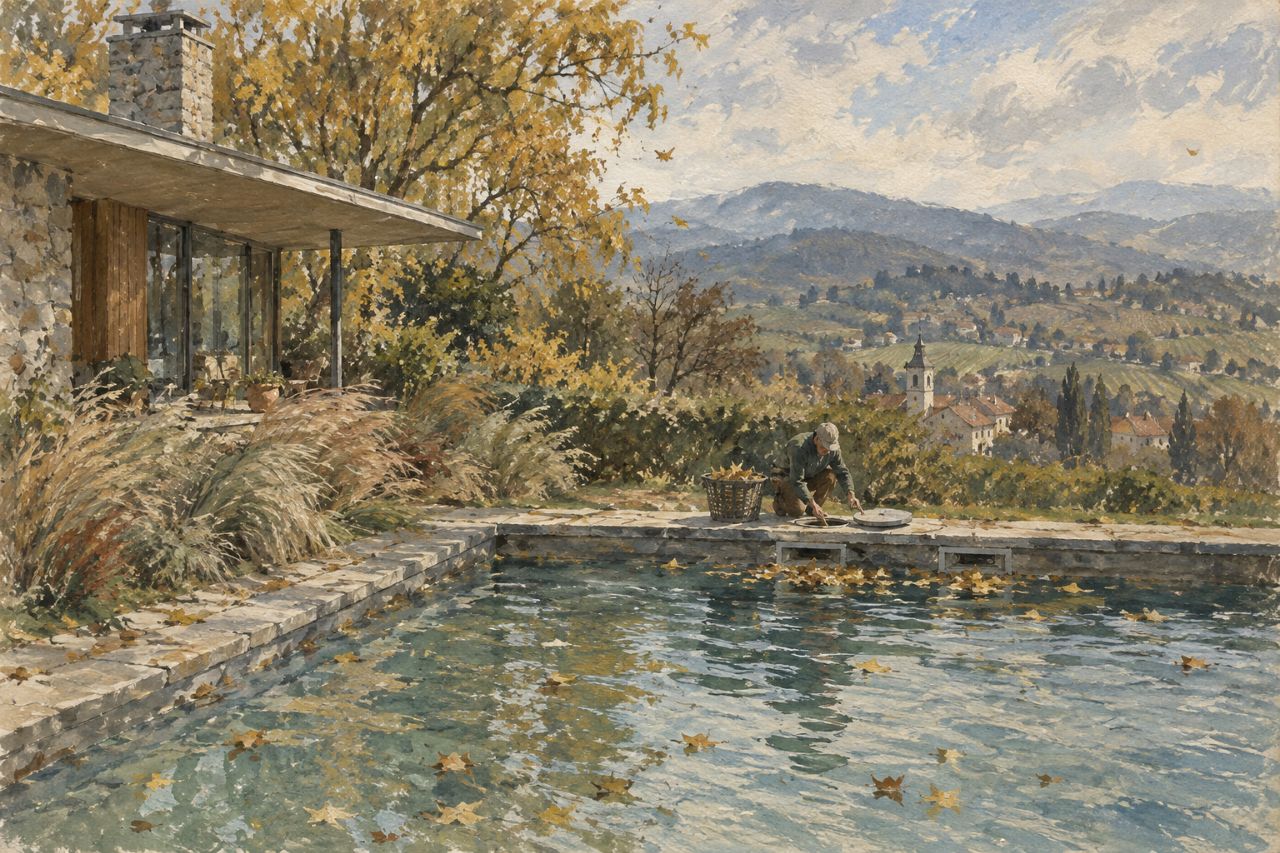
Close the pool when the water stays below about 15 °C (60 °F), and before the first hard frost. Below that temperature algae slow right down and what you add to the water lasts; above it, a closed pool can turn green under its cover in a warm spell. In most of central and northern Europe that means October or early November. Keep netting leaves out until the day you close, because a cover goes on a clean pool.
The first question is whether to close at all. Where winters are short and mild, with nights that dip below freezing now and then and days that do not, a pool can be run through the winter: full to its normal level, cover on, pump running on frost nights. That is active wintering, and it is a real alternative to the closing described here. Where the ground freezes for weeks, or a hard frost can last several nights, a full closure is the safe choice: the water goes down, the pipework is emptied and the pool sleeps until spring. The section on climate says where the line falls.
Decide in summer rather than in November. The things that make closing easy — an isolating valve on every line, a drain at the lowest point of the plant room, a cover whose anchors were cast into the deck — are built, not bought, and it is far cheaper to draw them than to dig them up.
What freezes in a pool, and what does not
Water expands by about 9% when it freezes, and it does so with great force. The pool itself usually survives: ice on open water has the whole surface to grow into, and a shell full of water is built to carry it. The damage is done where ice meets something rigid, and to anything that holds water in a closed space: pipes, the pump housing, the filter, a heat pump's heat exchanger, a skimmer throat, a return fitting, dosing lines, a salt cell.
Two places go first, and neither is in the plant room. The skimmer is a box set into the wall with its mouth at the water line, so ice that forms across the mouth and inside the box presses on a thin plastic throat. The waterline tile takes the same push from the ice sheet. Both are the reason a full closure lowers the water below them. Where the water stays in a skimmer, an ice compensator — a squeezable bottle or a foam insert — takes the ice's push instead of the housing.
The ground has a say too. A pipe buried above the local frost depth is the first to freeze, and the deeper the frost goes, the longer a cold spell has to last before the water in the lines is at risk. Ask whoever laid your pipework how deep it lies, and whether every line slopes to a drain. A pool whose pipes empty cleanly is easy to close; one whose pipes hold water in a sag is not.
Two weeks before: clean, balance and filter
Closing day is the end of a fortnight's work. Brush the walls and floor, vacuum, empty the baskets, and take out everything that can be stored: floats and toys, the robot, the thermometer, solar mats, and the ladder and handrails if their sockets allow it. Net the surface clean. Whatever is left on the floor will stain it.
Then balance the water, because it has to hold for five months with nobody looking at it. Bring pH to 7.2–7.4, total alkalinity to 80–120 mg/l and calcium hardness to 200–300 mg/l, the same bands as in summer: water that is too acid etches plaster and grout and attacks metal, and water that is too hard scales the waterline. Test with a proper kit rather than a strip, and correct pH first, as always. Backwash a sand filter or rinse a cartridge now, then run the pump long enough for the water to turn over twice.
The pool itself can take the cold. It is the water trapped in the pipes, the pump and the heat pump that cannot.
Shock, and what to add for the winter
Shock treatment is the last thing done to the water before it is covered: a deliberate, short overdose of sanitiser that oxidises whatever the summer left behind. Do it at dusk with the pump running, as the maintenance guide describes, and take any cover off the water first, because chlorine wears out a solar cover and the cover guide says never to shock with a cover closed. Let the chlorine fall back towards its normal range before the next step; the product label says how long.
Then the winter chemicals. A winterising product, usually a slow-acting algaecide with a stain and scale inhibitor, sold as a kit, keeps the water clear while it is cold and still. Dose it for the water you have, not the brochure's figure: a 26 × 13 ft (8 × 4 m) pool holds about 11,624 gal (44 m³) at the water line, the number on its plan page, and the volume calculator will work out any other size. Run the pump for a few hours afterwards so it mixes. Follow the product label and the rules where you live, including what may be tipped into a drain, a garden or the street later.
A salt pool follows the same steps with one change. Most salt cells make little or no chlorine in cold water, and the maker's manual says from what temperature, so switch the cell off for the winter, take it out and clean it if it can be removed, and leave the salt in the water: salt does not evaporate and does not need adding again in spring. Whether salt water or chlorine suits your pool is a design question of its own, and the comparison page takes it apart.

The water level: how far to lower it, and why never to empty
A full closure lowers the water to below the skimmer mouths, by a hand's width or two, about 3 7/8–7 7/8″ (10–20 cm), so ice cannot form across them. If you will blow out and plug the return lines, go below the return fittings too, so the lines can be emptied. Where the winter cover's maker gives a level, use theirs: a cover that touches the water sags as it fills with rain and leaves. A skimmer pool's water already stands about 5 7/8″ (15 cm) under the coping; from there, a closing drop of roughly 7 7/8″ (20 cm) is what you pump off.
The arithmetic is gentle. Lowering a 26 × 13 ft (8 × 4 m) pool, 344 sq ft (32 m²) of surface, by 7 7/8″ (20 cm) takes out about 1,691 gal (6.4 m³), a seventh of the water: an afternoon with a submersible pump, or with a sand filter's waste setting. Send it where the rules allow. A drain, a garden and the street are not equally acceptable, and water with winter chemicals in it is not plain water, so ask your authority before you pump.
Never empty the pool. An empty shell is lighter than the ground around it, and groundwater can lift it out of the earth; that is what the hydrostatic valve is for, and why nobody should drain a pool without asking the builder. A fiberglass shell and a liner both float in a high water table, and a liner left without water dries, shrinks and wrinkles. So lower the level, don't empty it, and keep it at the closing level until spring.
Blowing out the lines, and emptying the plant room
With the water below the fittings, the pipework is next. Blow compressed air, or a shop vacuum set to blow, down each line from the plant room until only air comes out at the pool, then push a rubber expansion plug into the fitting before any water runs back. Do the skimmer lines and the returns one at a time, then any line to a waterfall, deck jets or a water-level device. A line that sits below the lowered water, such as the main drain, cannot be emptied that way: do what the builder or the maker says. Ask for the drawing of where every pipe runs, so that nobody guesses in October.
In the plant room, switch off at the isolator first. Take out the drain plugs of the pump and the filter and keep them in the pump basket, where you will look for them in spring. Backwash a sand filter and set its multiport valve to the winter position, so water cannot sit on its seals; take the cartridges out of a cartridge filter, wash them and store them dry. Empty the dosing lines, store the pH probe as its maker says, take out the salt cell and the robot, and keep every electronic part indoors. Probes dry out, cells scale and plastic splits.
The heat pump needs the most care, because its heat exchanger holds water with no pipework to drain through. Drain it as its manual says, disconnect the unions so that the water in the unit can run out, and cover the unit with a breathable cover rather than a sealed bag, which holds condensation in. A heat pump that sat full through a frost is among the costliest mistakes on this page. If a line cannot be emptied, ask the equipment's maker which product they accept; car antifreeze is toxic and does not belong in a pool's pipes.
Covers: what goes over the water, and what holds it down
A winter cover has one job: to keep five months of leaves, light and unsupervised children out of the water. Tensioned mesh anchored into the deck is the practical choice, because rain and snowmelt pass through while debris stays on top; a solid cover is cheaper and needs a pump to clear the rainwater, and nobody thinks of the pump at six in the morning in March. A slatted cover can overwinter on the water in a mild climate, but ice crushes slats, so ask the maker about the level and the floaters before you rely on it.
Put the cover on a clean, shocked, balanced pool, and check on the first day that it is clear of the water and tight at every anchor: wind lifts a loose edge, and a cover that touches the water sags. Then check it after the first storm, after the first snow and once a month. A winter cover is a safety device as well as a lid, and one that has slipped is worse than none.
Active wintering, and what changes with the climate
In a mild climate, closing is a lot of work to fight a threat that comes a few nights a year, and many owners now leave the pool running: full to its normal level, a cover on, the pump on a frost thermostat that starts it when the air nears freezing. Moving water does not freeze as readily, and the pipes never sit full and still. The pool is blue in April and opening it is a morning rather than a weekend.
It comes with conditions. It needs a pump and a power supply you can trust through a cold night, because a pump that fails in a hard frost leaves the pipes frozen with none of the preparation of a closure. The heat pump is drained all the same, there has to be enough sanitiser in the water, and the cold has to end. If winter nights hover around freezing for a few days at a time, active wintering works; if the temperature stays well below it for a week, close the pool.
So the climate decides. Where winters are cold and long, as in much of Poland, Hungary, Germany and the northern United States, close fully and expect the pool to stay shut from October to April. Where frost comes in short spells, close or keep running by how the pool is built and whether you will be there to watch it. Where it almost never freezes, as on Mediterranean coasts, closing is a choice, not a precaution: the pump runs for fewer hours, the sanitiser is turned down and a cover keeps the leaves out.
What changes with the way the pool is built
A concrete pool, tiled or plastered, takes winter well when it is full of water, which is what it was designed to carry. What it needs is care at the tile line, where ice presses on the finish and each freeze and thaw widens any hairline gap in the grout or under the coping, so the level goes below the tile and the coping is checked in spring. Fiberglass and vinyl liner both flex a little with the ground, so frost is kinder to them, but each has its own rule about water: a fiberglass shell stays full in wet ground, and a liner needs water behind its folds to stay smooth. Never drain either without the maker's word.
A deck-level overflow pool has a balance tank and an overflow channel, and both are closed too. The tank holds roughly 5–10% of the pool's volume in the plant room, and its float valve, its pipes and the channel's outlet are what freeze, so ask the builder for a closing sequence for the tank in writing. A raised pool is the exposed case: cold reaches its walls and pipes from every side, so they freeze first and need the most care.
Opening in spring, and what to do if it is green
Opening reverses closing, in order. Pump the rainwater off the cover, brush the leaves into a heap, lift it off, then wash and dry it before it goes into storage; a cover put away damp is ruined by summer. Refill the pool to its normal level, above the skimmers, and refit what you took out: the plugs, the drain plugs, the cell, the probes, the ladder. Open the valves and prime the pump, and watch it for a minute. A pump started dry is a pump broken.
Then the water. Test it, bring pH and alkalinity into band, shock at dusk and filter continuously for a day or two until it clears, as the maintenance guide says. Reconnect the heat pump last, once water is flowing through it. A pool closed properly opens in an afternoon, and one closed badly opens over a weekend.
If the water is green when the cover comes off, treat it like a green pool in summer: correct the pH first, shock, brush every surface and filter until it clears, and leave the heat pump alone until it does. The cause is nearly always a closing in which the pool was dirty, out of balance or not covered tight, and the fix is next autumn's.
Closing the pool begins at the design stage
A pool that is easy to close was drawn that way. Put an isolating valve on every line in the plant room, with a drain at the lowest point and lines that slope down to it. Keep the equipment where frost cannot reach, in a closed room at least. Cast the cover's anchors into the deck while it is poured, as you do the ladder's sockets.
Size the winter dose from the volume your own plan prints, not the brochure's: find your size in the plan library, or enter the pool's real outline in the pool volume calculator if it is not a plain rectangle.
Closing day, in order
- Brush, vacuum and net the pool, empty the baskets and take out what can be stored.
- Balance the water: pH 7.2–7.4, alkalinity 80–120 mg/l, calcium hardness 200–300 mg/l.
- Clean the filter and run the pump for two turnovers.
- Shock at dusk with the pump running and any cover off, then let the chlorine settle as the label says.
- Add the winter product for the water-line volume and run the pump for a few hours.
- Lower the level below the skimmer mouths, and the returns if you blow out the lines: never empty the pool.
- Blow out and plug the lines, drain the pump, filter and heat pump, and keep the plugs together.
- Take out the salt cell, the probes, the robot and the ladder, and store them indoors.
- Fit the cover clear of the water and tight at every anchor.
- Check the cover after the first storm, after the first snow and every month.
What goes wrong in practice
Emptying the pool
People drain a pool to be safe from frost. In wet ground an empty shell can float out of the hole, and a liner left without water shrinks and wrinkles. Lower the level, do not empty it, and ask the builder before going any lower.
Closing a dirty or unbalanced pool
Leaves and a pH that drifted out of band spend five months under the cover etching plaster, staining the floor and feeding algae. Clean and balance two weeks before closing, not on the day.
Forgetting a drain plug, or the heat pump
The pump and the filter each keep their water until the plugs come out, and the heat pump's exchanger keeps its own. Take the plugs out, keep them in the pump basket, and drain the heat pump as its manual says.
A cover that touches the water
Wind lifts a loose edge and a cover that reaches the water sags as it fills with rain and leaves, then slides in. Check it is tight at every anchor, and check it again after the first storm.
Shocking under the cover
Chlorine and a closed cover do not mix, and the cover guide says never to shock with one on. Shock at dusk with the cover off, let the level settle, then cover the pool.
Frequently asked questions
- When should I close my pool for the winter?
- When the water stays below about 15 °C (60 °F) and before the first hard frost, which in central and northern Europe is usually October or early November. Algae are slow by then and what you add lasts through the winter.
- How low should the water be for winter?
- For a full closure, below the skimmer mouths by about 3 7/8–7 7/8″ (10–20 cm), and below the return fittings if you blow out and plug the lines. If the winter cover's maker gives a level, use that one. In active wintering the level stays normal.
- Do I have to drain a pool for winter?
- No, and you should not empty it. An empty shell can be lifted by groundwater and a liner shrinks without water. Lower the level and empty the pipes, the pump, the filter and the heat pump instead.
- Can I leave my pool open all winter?
- In a mild climate, yes: keep it full, covered and circulating on frost nights, and drain the heat pump all the same. Where the cold lasts for days on end, close it fully, because a pump failure in a hard frost freezes the pipes.
- How do I winterize a salt water pool?
- The same steps, plus the cell: switch it off, because most cells make little chlorine in cold water, take it out and clean it if it can be removed, and leave the salt in the pool. Add the winter product as the label says.
- How long does it take to close a pool?
- A morning to a day for the closing itself, after about two weeks of cleaning and balancing the water beforehand. Opening in spring takes an afternoon for a well-closed pool and a weekend for one that was not.